Before the Classroom: Why Curriculum Is Political
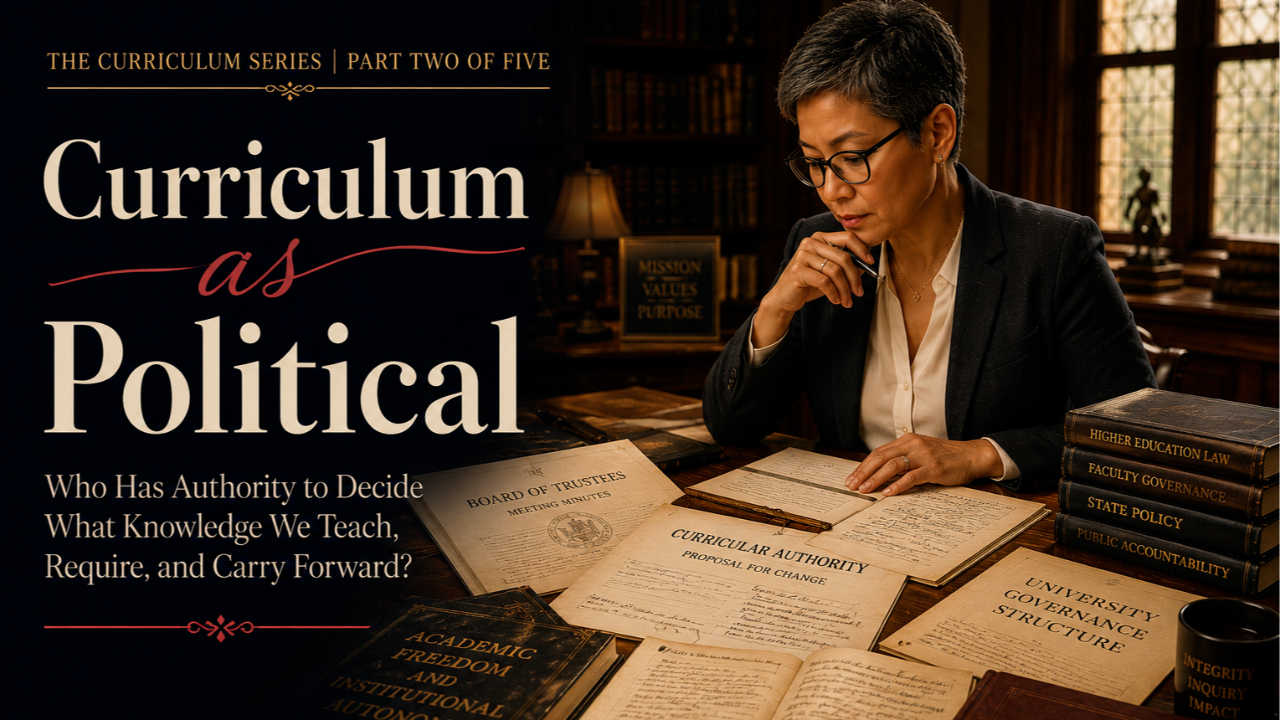
Curriculum Series, Part Two
In the first essay of this series, Before the Syllabus: Why Curriculum Becomes the Site of Institutional Struggle, I argued that curriculum is fundamentally an epistemic enterprise.
Before an institution can teach knowledge, it must first determine what knowledge is legitimate enough to become part of its educational mission. Every syllabus, degree requirement, and program of study begins with a deceptively simple question:
What counts as knowledge?
But once an institution decides what knowledge will be recognized, preserved, and taught, another question immediately follows:
Who has the authority to decide?
That is where curriculum moves from epistemic to political.
Why Disagreement Is Not the Political Problem
For many readers, the claim that curriculum is political immediately evokes contemporary cultural debates, partisan conflict, or ideological disagreement. While those conflicts are certainly visible today, they do not explain why curriculum is political in the first place.
Universities have always contained disagreement. Faculty have debated theories, challenged assumptions, revised disciplines, and contested one another’s conclusions for centuries. Disagreement is not an indication that the system has failed. It is one of the conditions under which scholarship advances.
The political character of curriculum emerges for a different reason. Scholarship may generate knowledge, but institutions must decide which knowledge becomes part of the educational enterprise. Research alone cannot determine what every student should learn, what every graduate should know, or which intellectual traditions deserve preservation. Those judgments require institutions to establish legitimate authority.
Politics, in this sense, is not the opposite of scholarship. It is the institutional process through which scholarly judgment becomes institutional judgment.
The Two Political Layers of Curriculum
Curriculum has always been political, but there are two distinct layers to that politics.
The first concerns how authority is negotiated within the university.
The second concerns whether the university retains the authority to govern curriculum at all.
The distinction matters because these two forms of political struggle are not the same, even when they converge around the same course, program, degree requirement, or academic policy.
The First Layer: Authority Within the University
Historically, the politics of curriculum occurred primarily inside the institution.
Departments evaluated disciplinary developments. Curriculum committees reviewed proposals. Faculty senates deliberated over academic policy. Deans and provosts weighed institutional priorities. Presidents and governing structures carried broader responsibility for the university’s academic direction.
These arrangements did not eliminate conflict. They created a legitimate process through which conflict could be negotiated. The central question was:
Who within the university possesses the authority to shape the curriculum?
Faculty brought disciplinary expertise. Academic leaders brought institutional responsibility. Departments defended intellectual traditions. Administrators considered resources, accreditation, enrollment, mission, and long-term viability. The politics existed in the distribution of authority among these actors.
Seen through this lens, shared governance was never merely an administrative arrangement. It was an epistemic arrangement. It established the processes through which expertise acquired institutional legitimacy and connected the production of knowledge to the authority to determine how that knowledge entered the curriculum.
The politics of curriculum did not exist despite shared governance. They existed through it.
The Second Layer: Authority Beyond the University
The contemporary moment reveals a different political struggle.
Increasingly, the central question is no longer simply how authority is distributed within the university. The location of authority itself is becoming contested.
Governing boards, legislatures, executive officials, donors, accrediting bodies, and members of the public are asserting greater influence over decisions that many institutions have historically understood to reside primarily within faculty governance and academic leadership.
The political question therefore changes. It is no longer only, Who within the university should decide? It becomes, Does the university still possess the authority to determine its own academic enterprise?
This is the second political layer. The first concerns the negotiation of authority within the institution. The second concerns whether that authority is being shared with, constrained by, or transferred to actors beyond the campus. These are fundamentally different struggles.
It is one thing for faculty, deans, provosts, and presidents to disagree about curriculum within an established governance structure. It is another for actors outside that structure to determine who is permitted to exercise academic authority in the first place.
The deeper question is no longer simply who gets to decide.
Who has the power to decide whether the university gets to decide at all?
Auburn as an Institutional Signal
Recent events at Auburn Univeristy illustrate this broader transformation.
Much of the public conversation focused on the restructuring of the Faculty Senate and the immediate implications for institutional governance. Yet the significance of the episode extends beyond a single campus.
The story is not simply about one senate, one board, or one university. It reflects a larger national conversation about where legitimate academic authority resides and who ultimately possesses the right to authorize institutional knowledge.
Viewed in this way, Auburn becomes less an isolated controversy than a window into a changing governance landscape. Similar questions are emerging across higher education as institutions negotiate the relationships among faculty expertise, executive leadership, governing boards, public accountability, and political oversight.
The visible disagreements concern policies and procedures. The deeper struggle concerns authority itself.
When the Two Layers Collide
These two political layers often become difficult to distinguish because they can appear within the same institutional conflict.
A debate may begin as an internal disagreement among faculty, administrators, and academic leaders. But when external actors intervene, restructure governance, redefine academic authority, or establish new limits on what may be taught, the conflict changes in kind.
What began as a question of internal governance becomes a question of institutional autonomy.
A course may still be the visible object of debate. A faculty senate may still be the body under scrutiny. A curricular requirement may still be the immediate policy question. But beneath those visible disputes are two different political struggles:
Who should exercise authority within the university?
And who possesses the authority to determine whether the university may govern itself?
Until those questions are separated, institutions may misread the nature of the conflict they are facing.
The Question Beneath the Curriculum Debate
This is why curriculum debates rarely remain confined to curriculum.
On the surface, institutions appear to be debating courses, programs, textbooks, degree requirements, or academic policies. Beneath those discussions lies a more fundamental question:
Who has the legitimate authority to determine what future generations will inherit as knowledge?
Every curriculum decision is simultaneously an academic judgment and an institutional judgment. It determines not only what is taught, but whose judgment becomes the university’s judgment.
Recognizing curriculum as political therefore requires a broader understanding of politics than the one typically found in public discourse. Politics is not merely ideological conflict. It is the ongoing negotiation of legitimate authority within and around institutions.
Curriculum becomes political because knowledge cannot become institutional until someone possesses the recognized authority to authorize it.
When Society Seeks to Shape Curriculum
This insight also explains why curriculum has become an increasingly visible site of public contestation.
As higher education’s influence on professions, civic life, and public understanding has become more apparent, questions about who governs curriculum have expanded beyond the campus.
The closer curriculum comes to shaping society, the more society may seek to shape curriculum.
This does not mean that every external intervention is illegitimate. Nor does it mean that every internal governance structure is beyond critique. Universities are public institutions, civic institutions, professional institutions, and cultural institutions. They are accountable to multiple constituencies.
But accountability and academic authority are not identical.
A governing board may possess fiduciary responsibility without possessing disciplinary expertise. A legislature may hold public authority without being equipped to determine the intellectual architecture of a degree. Faculty may possess academic expertise without carrying sole responsibility for the institution’s long-term viability.
The challenge is not to eliminate these tensions. It is to recognize what kind of authority each actor holds, where that authority begins, and where it should end.
Without that clarity, institutions risk confusing oversight with academic judgment, accountability with control, and governance with the power to determine knowledge itself.
What Authorized Knowledge Begins to Do
In the first essay, we asked what counts as knowledge.
In this essay, we have asked who possesses the authority to authorize that knowledge.
Those questions, however, still leave one important dimension unexplored.
Once knowledge has been authorized, it does not remain within committee rooms, governance documents, or university catalogs. It begins shaping the people who move through those institutions.
Curriculum prepares professionals, legitimizes particular ways of thinking, and gradually forms the assumptions that graduates carry into their work and their communities.
That is where this series turns next.
Pulling the Thread
If Part One explored curriculum as an epistemic enterprise and Part Two examined curriculum as a political enterprise, Part Three asks a different question altogether:
What does curriculum produce?
Once knowledge has been authorized, it begins doing its quiet work. It shapes identities, professions, institutions, and ultimately the society those institutions help create.
That is why the struggle over curriculum never ends with a syllabus.
The authority to shape curriculum is also the authority to influence how future generations learn to understand the world.
Dr. Nicole R. Robinson The Institutional Whisperer
Continue the Conversation
If your institution is navigating a complex challenge, I’d be glad to explore it with you.