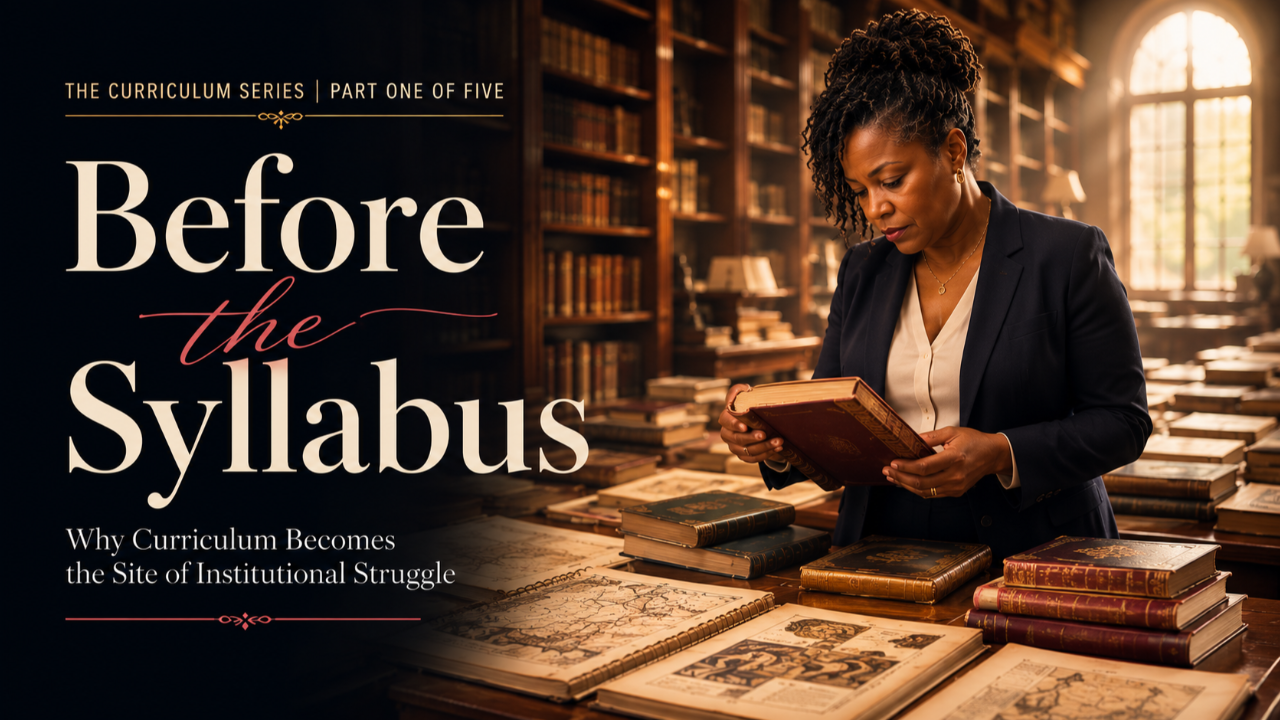
Before the Syllabus: Why Curriculum Becomes an Institutional Struggle
A few weeks ago, I asked a question that has continued to shape my thinking.
Of all the places where a shift in governance and institutional authority could appear, why did curriculum sit so close to the center? Why would control over curriculum become consequential enough to warrant structural intervention?
READ THE ARTICLE THAT STARTED THIS INQUIRY: What Auburn Revealed about Curriculum and Power
At first glance, the answer might appear procedural. Curriculum is a major faculty responsibility. It moves through committees, governance bodies, accreditation processes, and administrative review. Changing who controls those processes changes how academic decisions are made.
But procedure alone does not explain why curriculum matters so deeply.
To understand why governance would reach toward curriculum, we have to understand what curriculum holds.
Curriculum is not simply where universities organize courses. It is where institutions decide which knowledge will be preserved, which knowledge will be legitimized, which knowledge will become required, and which knowledge students will carry into the professions and communities they eventually influence.
That is what makes curriculum consequential.
When authority over curriculum shifts, the institution is not merely changing how courses are approved. It may also be changing who has the power to determine what counts as legitimate knowledge, what an educated person should know, and what intellectual inheritance the institution will carry forward.
This series is my attempt to answer the question Why the curriculum? from several connected layers.
We begin with the epistemic layer because before curriculum becomes a matter of governance, policy, or political authority, it is first a decision about knowledge.
The Journey Ahead
Each issue in this series will answer the same central question from a different perspective.
Part One | Curriculum as Epistemic Why curriculum matters because it institutionalizes knowledge.
Part Two | Curriculum as Political Why curriculum matters because it institutionalizes authority over knowledge.
Part Three | Curriculum as Productive Why curriculum matters because it helps produce professions, identities, institutions, and social realities.
Part Four | Curriculum as Worldview Why curriculum matters because it shapes how people understand themselves, others, and the world.
Part Five | The Architecture of Curriculum Why curriculum matters because, taken together, these layers help construct the intellectual identity of the university itself.
The first question, then, is not simply what courses appear in the catalog. It is this: Curriculum is what knowledge has the institution decided to institutionalize?
The Central Argument
Long before a course is approved, a program is launched, or a student registers for class, an institution has already made a series of judgments. It has determined that certain knowledge deserves sustained attention. It has accepted particular methods of inquiry as rigorous, recognized some forms of evidence as credible, and concluded that specific histories, ideas, competencies, and intellectual traditions should become part of what an educated person is expected to know.
These are epistemic decisions.
The word epistemic comes from epistemology, the branch of philosophy concerned with knowledge. Epistemology asks what knowledge is, how it is established, what counts as evidence, how truth claims are justified, and whose knowledge becomes recognized as legitimate.
Universities answer those questions through curriculum.
An institution may never publish a formal statement explaining its theory of knowledge, but its curriculum communicates that theory continuously. Required courses, accepted methods, faculty specializations, credentialing standards, and learning expectations reveal which forms of knowledge have been granted institutional standing. Curriculum is where philosophy becomes institutional practice.
The philosophical assumptions that undergird a curriculum do not remain abstract. They become courses, requirements, sequences, methods, assessments, and degrees. They influence what students are expected to master and what faculty are authorized to teach. Through curriculum, a theory of knowledge becomes part of the organizational life of the university.
Knowledge, however, exists far beyond the university. Communities, professions, artists, tradespeople, faith traditions, families, social movements, and Indigenous cultures all possess and produce knowledge. The university does not decide whether that knowledge exists. It decides whether that knowledge will be formally recognized, preserved, taught, credited, and credentialed.
That distinction matters. Universities do not confer existence upon knowledge, but they do confer institutional legitimacy. Through curriculum, selected knowledge becomes attached to academic authority, institutional resources, faculty expertise, and the meaning of a degree.
Curriculum is therefore the process through which selected knowledge becomes educational inheritance.
Every generation inherits knowledge it did not create. It receives scientific discoveries, historical narratives, artistic traditions, ethical frameworks, professional practices, and ways of interpreting the world from those who came before. Curriculum helps determine which parts of that inheritance will be formally preserved and entrusted to the next generation.
In this sense, curriculum performs three interrelated functions. It preserves knowledge by giving it a durable place within the institution. It legitimizes knowledge by attaching academic authority, institutional resources, and credentials to it. It transmits knowledge by carrying it from one generation to the next.
Together, these functions transform selected knowledge into educational inheritance.
A required course, then, represents more than a place on a degree plan. It reflects an institutional judgment that particular knowledge should not be left to chance. By requiring students to devote time and intellectual effort to a body of knowledge, the institution declares that students should not graduate without encountering it.
Every requirement carries an act of intellectual confidence. The institution is asserting that this knowledge matters enough to claim a portion of a student’s educational life.
Seen this way, curriculum also becomes an act of institutional memory. It helps determine what a university will continue to remember, teach, and carry forward. Curricular revision, therefore, is never merely an exercise in adding and removing courses. It is also a reconsideration of what should remain within the institution’s intellectual memory.
Some curricular changes are necessary and generative. Disciplines evolve, new knowledge emerges, professional expectations change, and inherited assumptions require examination. A curriculum that never changes would cease to fulfill its intellectual purpose.
Yet change is not neutral simply because it is necessary. Every revision still raises questions about what will be preserved, what will be reinterpreted, and what may no longer be carried forward. It asks the institution to decide what knowledge deserves to survive within its formal educational inheritance.
That is why curriculum becomes such a consequential site of institutional authority.
Every Curriculum Makes an Argument
Curriculum is often treated as though it were a neutral container into which knowledge is placed. It is not. Every curriculum makes an argument about what matters, what an educated person should know, what a profession requires, which questions deserve sustained attention, and which forms of knowledge should shape the next generation.
Because no curriculum can include everything, selection is unavoidable. Institutions must decide what will be required, what will remain optional, and what will sit outside the formal educational experience. Those choices do not automatically make a curriculum unjust or intellectually suspect, but they do make it consequential.
The important question is not whether curriculum reflects priorities. It always does. The deeper question is whether an institution can recognize, articulate, and defend the assumptions beneath those priorities.
What theory of knowledge is being advanced? What understanding of evidence is being privileged? What vision of professional competence is being constructed? Which ideas have been positioned as foundational, and which have been treated as peripheral? What knowledge has become so deeply institutionalized that it is no longer recognized as a choice?
These questions move curricular analysis beyond course sequencing, credit hours, and approval processes. They allow us to see curriculum as an argument about reality itself.
Institutions publish mission statements, strategic plans, values, priorities, and public commitments. Those documents matter, but they often describe who an institution hopes to become. Curriculum reveals what the institution is prepared to teach, preserve, support, and credential.
In that sense, curriculum is where a university introduces itself.
It tells students what the institution believes they must encounter before they can claim the meaning of its degree. It tells faculty which bodies of knowledge the institution will organize itself around. It tells professions what the university considers appropriate preparation, and it tells the public what forms of knowledge the institution is prepared to preserve and endorse.
If we want to understand what an institution truly values intellectually, we should examine not only what it says, but what it requires. A mission statement may describe an institution’s aspirations. A curriculum reveals its intellectual commitments.
Before Curriculum Shapes Students, It Shapes the Institution
We usually discuss curriculum in terms of its effect on students. We ask what they will learn, what competencies they will develop, what perspectives they will encounter, and who they may become. Those questions matter, but curriculum begins shaping the institution long before it shapes the student.
The knowledge an institution chooses to preserve influences which faculty it hires, which departments it maintains, which research it supports, which facilities it builds, which partnerships it pursues, and which forms of expertise it elevates. Curriculum shapes resource allocation, organizational structure, faculty authority, institutional reputation, and the professional identities that become most visible and valued.
Curriculum does not merely express institutional identity. It helps produce it.
An institution becomes organized around the knowledge it chooses to preserve. Its structures, investments, and forms of authority begin to reflect the intellectual commitments embedded within its curriculum.
Returning to the Original Question
We can now return to the question that opened this series.
Why the curriculum?
If curriculum were merely a collection of courses, it would be difficult to explain why governance structures, boards, administrators, legislators, or other external authorities would seek greater influence over it. Universities revise courses and degree requirements regularly. On the surface, curricular change can appear routine.
But curriculum is not merely an administrative arrangement.
It is one of the primary mechanisms through which an institution determines what knowledge will be preserved, legitimized, transmitted, and attached to the authority of a degree. To influence curriculum is to influence what future graduates will be expected to know, which intellectual traditions will remain foundational, how professions will be defined, and how institutional memory will be preserved.
It is also to influence what the university is prepared to recognize as truth, evidence, expertise, and legitimate inquiry.
That is why changes in curricular authority cannot be understood only as changes in governance procedure. They may also represent a transfer of authority over the intellectual identity of the institution.
The struggle is rarely only about courses. It is about who possesses the authority to determine which knowledge becomes institutionalized.
Perhaps that is the beginning of the answer.
Curriculum becomes a site of institutional struggle because curriculum is one of the places where institutions decide what knowledge will survive them.
Pulling the Thread
The question Why the curriculum? became the catalyst for this series. The earlier essay examined what could be seen in a particular shift in governance and authority. This issue has moved beneath that visible change to consider what makes curriculum consequential enough to become the object of institutional struggle.
The epistemic layer gives us the first part of the answer. Curriculum matters because it institutionalizes knowledge. It determines which knowledge will be formally preserved, legitimized, taught, and attached to the authority of a degree.
In the next issue, we will move from knowledge to authority as we examine Curriculum as Political. Once an institution has determined that some knowledge will become institutionalized, another question follows: Who gets to decide?
Read Behind the Read: What Auburn Revealed about Curriculum and Power, the essay that opened this inquiry into curriculum, governance, authority, and institutional change.
Dr. Nicole R. Robinson,The Institutional Whisperer