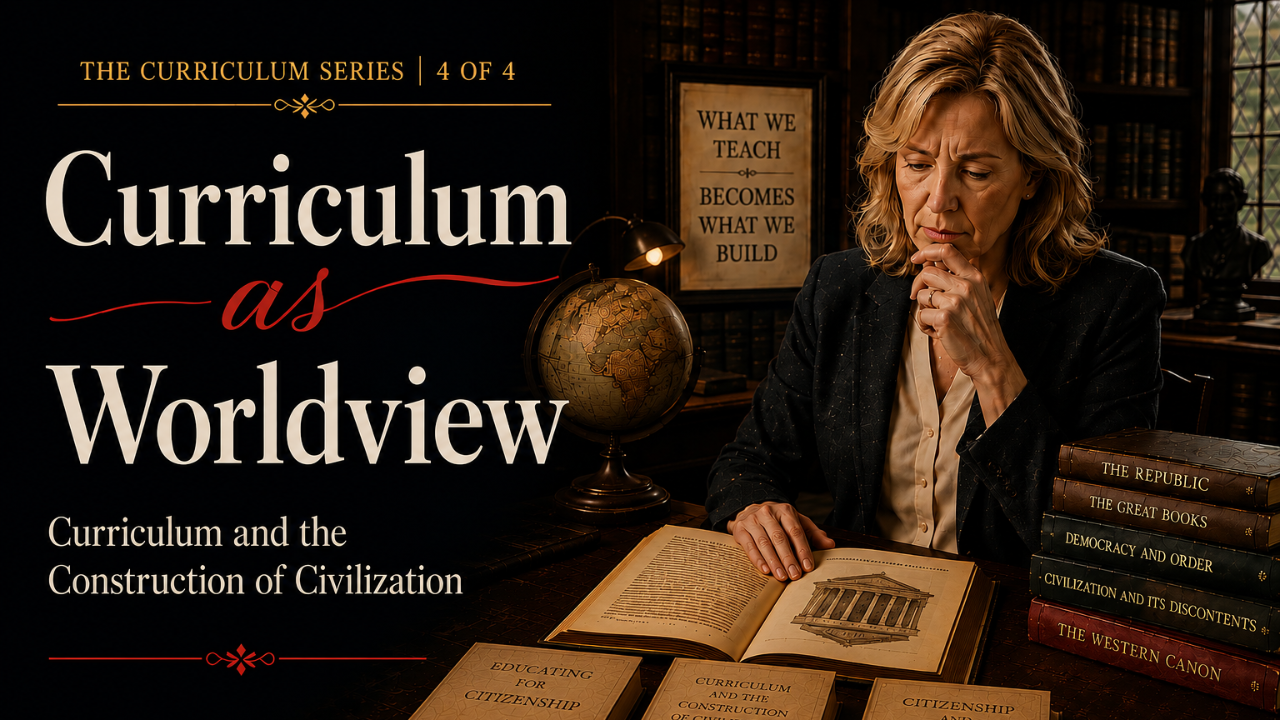
Part Four | Curriculum as Worldview
The curriculum series began with a question that, at first glance, appeared to concern governance. At Auburn University, a decision by the governing board to intervene in curriculum prompted a national conversation about authority, academic freedom, and institutional autonomy. The public debate centered on familiar questions. Who should determine what is taught? What authority belongs to faculty? What authority belongs to governing boards? Those questions were important, and they remain important today.
As this series unfolded, however, it became clear that those questions were pointing toward something larger. We first explored curriculum as epistemology, asking what knowledge is recognized as legitimate within the academy. We then examined curriculum as politics, considering who possesses the authority to determine that knowledge. Most recently, we considered curriculum as production, reflecting on the kinds of professionals, citizens, and leaders higher education ultimately sends into the world.
Each essay examined a different dimension of curriculum. Together, they reveal that curriculum has never been merely an academic enterprise. It is one of the principal ways societies transmit knowledge, negotiate authority, shape human development, and ultimately influence how future generations understand the world they inherit.
That realization brings us to the final question in this series.
What kind of worldview does a curriculum cultivate?
Worldview Is Indispensable to Being Human
Before we can understand why curriculum matters so deeply, we must first understand something more fundamental about ourselves.
Human beings are not merely information-processing creatures. We are meaning-making creatures. We do not encounter reality as a collection of isolated facts waiting to be assembled. We continually interpret what we experience. Every relationship, institution, historical event, scientific discovery, and cultural practice is understood through an interpretive framework that helps us answer enduring questions about truth, responsibility, justice, identity, purpose, and possibility.
That interpretive framework is what we call worldview.
The term is often reduced to political ideology or religious belief, but worldview is far more encompassing than either. It is the lens through which people recognize significance, evaluate evidence, assign meaning, and imagine what is possible. Whether consciously examined or unconsciously inherited, every person possesses a worldview because no human being encounters the world without interpreting it.
Worldview, therefore, is not optional. It is indispensable to being human.
The more meaningful question has never been whether people possess a worldview. The enduring question is how that worldview is formed, refined, challenged, and transformed throughout a lifetime.
Institutions Participate in Worldview Formation
If worldview is an inevitable part of being human, then every institution that participates in human development inevitably participates in worldview formation.
Families introduce children to foundational beliefs about belonging, responsibility, and identity. Religious communities cultivate moral and spiritual understandings. Cultural traditions transmit shared narratives about history, memory, and purpose. Media shapes public perception through the stories it elevates and the assumptions it normalizes.
Education occupies a distinctive place among these institutions because it introduces individuals to disciplined ways of understanding reality. Universities do not simply present information. They teach students how questions are constructed, what counts as credible evidence, how arguments are evaluated, what standards define expertise, and how knowledge itself is produced.
This observation should not be understood as either praise or criticism of higher education. It is simply a recognition of its institutional role.
Education does more than expand what students know.
It reshapes how they know.
That distinction is easy to overlook because universities understandably describe themselves through visible structures: curricula, degree plans, learning outcomes, accreditation standards, and competencies. Those structures are essential. They provide the organizational framework through which teaching occurs.
Yet beneath that visible framework lies another process that is equally significant, though far less apparent.
Students are gradually learning how to interpret reality.
Curriculum as Society’s Interpretive Infrastructure
Infrastructure is often most influential precisely because it is rarely noticed. Roads determine how people move through communities. Water systems sustain everyday life. Electrical grids distribute power across entire regions. Communication networks shape how ideas travel. These systems quietly organize human activity while remaining largely invisible to those who depend upon them.
Curriculum functions in much the same way.
It quietly organizes the interpretive pathways through which societies teach future generations how to understand themselves, one another, and the world around them.
For this reason, curriculum may be understood as society’s interpretive infrastructure.
It is the institutional architecture through which inherited knowledge is transmitted, established assumptions are examined, emerging realities are interpreted, and new possibilities become imaginable. Long before graduates assume positions of leadership, they have already spent years learning not only particular bodies of knowledge but also particular habits of interpretation.
People often notice curriculum only when someone proposes changing it.
Its influence, however, has always been present.
Every Curriculum Teaches Twice
Perhaps one of the least visible characteristics of curriculum is that every curriculum teaches twice.
The first lesson is the one institutions intentionally design. Students learn biology, economics, literature, engineering, nursing, philosophy, or history. They develop technical competencies, professional expertise, and disciplinary knowledge.
The second lesson is quieter, yet ultimately more enduring.
Students also learn what constitutes legitimate evidence. They learn whose voices become part of historical memory and whose perspectives remain peripheral. They learn how authority is established, what professional responsibility requires, what problems deserve attention, and what futures appear both possible and desirable.
The visible curriculum teaches content.
The hidden curriculum teaches interpretation.
No single course determines a person’s worldview. Yet over time the accumulated experience of a curriculum shapes habits of perception that often endure long after individual facts have faded from memory.
Perhaps the most enduring outcome of higher education is not simply what graduates remember.
It is how they have learned to understand.
Curriculum and the Construction of Civilization
At this point, the previous essays begin to converge.
Knowledge influences interpretation.
Authority influences knowledge.
Curriculum shapes human development.
Human development shapes worldview.
Worldview influences the institutions people build, the policies they create, the professions they practice, the communities they sustain, and the futures they imagine.
Those institutions then revise curriculum for the generation that follows.
Curriculum therefore participates in a continuous civilizational process. It becomes one of the mechanisms through which societies preserve inherited understandings, reconsider them in light of changing realities, and transmit revised ways of seeing to those who come next.
Curriculum is not simply an educational mechanism.
It is one of civilization’s recursive processes.
Through curriculum, societies continually negotiate the relationship between inheritance and change.
Reading Auburn Differently
Returning to Auburn at the conclusion of this series reveals something that was difficult to see at the beginning.
The public debate centered on governance. It asked who possessed the authority to determine curriculum and where institutional authority should reside.
Those questions remain important.
But they were not the deepest questions.
Seen through the progression of this series, governance was the visible debate. Curriculum was the object of debate. Worldview was the deeper stake.
That insight extends well beyond Auburn. It helps explain why curriculum has rarely remained an issue confined to universities. Across history and across societies, debates over curriculum repeatedly become debates about the future because curriculum quietly participates in shaping how future generations understand the world.
Perhaps this is why curriculum has always mattered far beyond the classroom.
Every society eventually confronts the same enduring questions. What knowledge should be preserved? What assumptions should be challenged? What kinds of people should education cultivate? What future should the next generation inherit?
The curriculum debates of our own moment are not unprecedented.
They are simply the latest expression of one of humanity’s oldest institutional questions.
What future is a society attempting to create through the curriculum it chooses to preserve, revise, or erase?
Continue the Conversation
This article concludes the four-part curriculum series.
If you’re joining the series here, I invite you to begin with the essay that started it all:
Read: Read Auburn Closely: Why the Auburn Curriculum Debate Matters Beyond Auburn
From there, continue through:
-
Part Four | Curriculum as Worldview (Current)
Together, these four essays explore curriculum not simply as an academic concern, but as one of the primary ways institutions shape knowledge, authority, human formation, and the future of society.