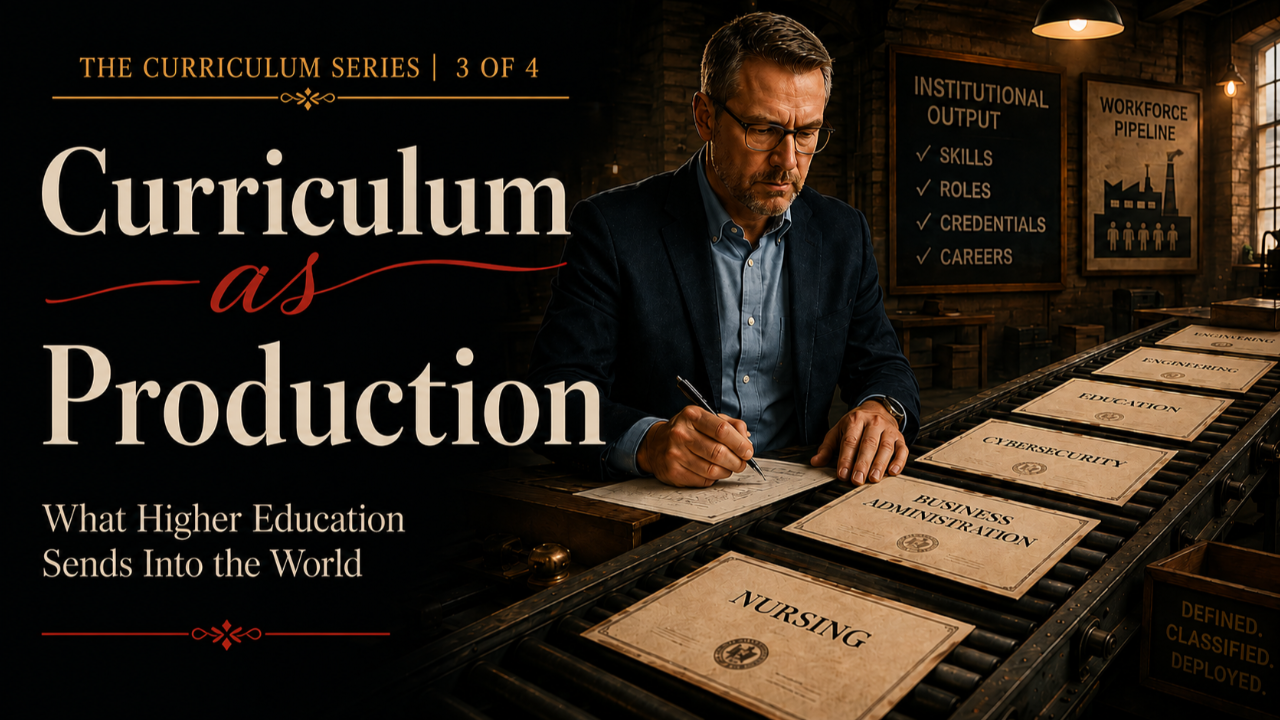
Part Three | Curriculum as Production
Over the past year, an unexpected question moved into public debate:
What counts as a professional degree?
The question emerged as the U.S. Department of Education developed new federal student-loan categories that distinguished between graduate programs and a narrower group of professional programs. Under the proposed definition, advanced nursing programs were excluded from the professional-degree category, along with programs in several other fields whose graduates perform highly specialized work requiring advanced education, professional judgment, and public trust.
Nursing became one of the most visible examples, in part because the consequences were immediately recognizable. Nursing organizations warned that excluding advanced nursing degrees from the category could make graduate education less accessible, weaken pathways into advanced practice and nursing education, and intensify existing workforce challenges.
But the controversy was never only about nursing.
It raised a broader question about how professions become recognized, resourced, and reproduced. Fields that had long understood themselves as professions suddenly found that their standing within one consequential federal system could be defined differently.
The immediate concern was financial. Students enrolled in programs classified as professional would have access to higher federal borrowing limits than students enrolled in programs classified as graduate.
But the controversy revealed something much larger.
The government was not simply deciding how much students could borrow. It was exercising the power to name a profession.
That distinction matters because classifications do more than organize programs. They communicate which forms of knowledge are considered sufficiently specialized, which forms of labor warrant particular investment, and which occupations are granted the social standing associated with professional life.
A nurse does not cease to perform professional work because a federal category changes. Neither does a physical therapist, architect, educator, social worker, or other highly trained practitioner whose field may fall outside a particular administrative definition.
Yet the category still matters.
It can affect financing, institutional behavior, educational access, workforce development, and public perception. The dispute therefore exposes a question that sits beneath many curriculum debates:
Who has the authority to decide which forms of knowledge become recognized professions, and which forms of work society will organize itself to sustain?
In the previous installment, Curriculum as Politics, I examined the two layers of authority that shape curricular decisions: authority exercised within the university and authority asserted beyond it. This article follows the next movement in that sequence, asking what happens after knowledge has been selected and the authority to authorize it has been exercised.
That question brings us to the third layer of this series.
Curriculum is epistemic because it determines what counts as legitimate knowledge.
Curriculum is political because it determines who has the authority to make that decision.
Curriculum is also productive because it converts knowledge into people, professions, institutions, and ways of living in the world.
Beyond What Curriculum Teaches
It is easy to describe curriculum as a body of educational content. Students enter a program, complete a sequence of courses, demonstrate proficiency, and receive a credential. From that perspective, curriculum appears to be a structured method for transferring knowledge.
But curriculum does more than transfer knowledge.
It produces capacity.
A nursing curriculum produces people who can diagnose conditions, administer care, coordinate complex health systems, educate patients, conduct research, and prepare future nurses. A teacher-education curriculum produces people who interpret childhood development, structure learning environments, evaluate student progress, and shape how future generations encounter knowledge. An engineering curriculum produces people capable of designing the physical and technological systems through which contemporary life operates.
Still, even this description is too limited.
To say that nursing programs produce nurses, law schools produce lawyers, or colleges of education produce teachers tells us only what appears at the end of the educational process. It does not tell us what those professions make possible once they enter society.
Nursing education does not merely produce nurses. It helps produce the conditions under which communities can survive illness, manage chronic disease, give birth safely, care for aging populations, and encounter dignity during physical vulnerability.
Teacher education does not merely produce teachers. It helps produce the conditions under which children learn what their society remembers, what it values, what it expects of them, and what futures they can imagine occupying.
Schools of social work do not merely produce social workers. They help produce the systems through which a society responds to trauma, poverty, displacement, family instability, disability, and human need.
Curriculum therefore produces more than workers. It produces the human infrastructure through which a society carries out its commitments.
This is the deeper meaning of curriculum as production.
The University as a Site of Social Production
Universities are often described as institutions that prepare people for the world.
That description suggests that the world already exists in a largely completed form and that higher education’s task is to help students enter it successfully. Students acquire knowledge, develop skills, choose careers, and take their place within an established social order.
But universities do not merely prepare people to enter the world.
They participate in producing the world those people will enter.
When an institution creates a degree program, expands one field, eliminates another, or redesigns the intellectual core of a profession, it changes more than its academic portfolio. It influences which kinds of expertise will become available, which social problems will receive organized attention, and which ways of understanding those problems will travel into hospitals, schools, corporations, courtrooms, laboratories, government agencies, and communities.
Universities do not simply produce graduates. They produce the human infrastructure upon which society depends.
Curriculum is one of the primary mechanisms through which academic knowledge becomes social reality.
An idea may begin in a discipline. It becomes organized through curriculum. Curriculum converts it into a sequence of learning. That sequence becomes a credential. The credential authorizes a person to occupy a role. Through that role, disciplinary knowledge begins shaping institutional decisions and human lives.
The movement is sequential:
Knowledge becomes curriculum.
Curriculum becomes formation.
Formation becomes professional capacity.
Professional capacity becomes social structure.
Curriculum is one of the few places where society intentionally designs its future human infrastructure before that future exists.
By the time the effects become visible in the world, the original curricular decisions that helped produce them may be almost impossible to see.
The classroom is where production begins, not where it ends.
Curriculum Produces the Professional
A profession is not simply an occupation requiring advanced skill. It is a socially authorized form of expertise.
Professionals are permitted to interpret situations that others may not be qualified to interpret. They are trusted to make consequential judgments. They are given access to people, systems, information, and decisions. Their knowledge is embedded in laws, licensing structures, ethical codes, institutional policies, compensation systems, and public expectations.
Curriculum helps construct that authority.
It determines what a future professional must know, what that person must be able to do, what standards must be met, what ethical obligations must be carried, and what kinds of judgment the professional will be expected to exercise.
Curriculum does not simply prepare someone for a profession that already exists. Curriculum continually recreates the profession itself.
Each graduating class carries forward a particular definition of competent practice. Each program communicates which knowledge belongs at the center of the field and which knowledge remains peripheral. Each accreditation standard stabilizes certain expectations about what the profession is and what it should become.
That is why disputes over professional curricula can become so intense. A curricular change may appear to involve the addition of a course, the removal of a requirement, or the revision of a competency. But beneath the visible decision lies a more consequential question:
What kind of professional are we now preparing to authorize?
A medical curriculum that treats social conditions as peripheral produces a different physician from one that teaches students to understand how housing, race, income, geography, and policy shape health.
A business curriculum centered almost exclusively on shareholder return produces a different executive from one that treats labor, community, environmental impact, and public responsibility as central to organizational decision-making.
A teacher-education curriculum that treats education as content delivery produces a different educator from one that understands teaching as intellectual, developmental, cultural, and civic work.
Curriculum does not dictate every decision a graduate will make. Human beings are not manufactured objects. They interpret, resist, revise, and exceed what they have been taught.
Yet curriculum establishes the intellectual architecture from which professional judgment begins.
It teaches future professionals what to notice, what to measure, what to question, what to protect, and what they may never learn to see.
Production Is Also Distribution
The productive power of curriculum does not stop with deciding what professionals know. It also influences who will be able to become one.
Every profession has an entry architecture.
That architecture includes tuition, admissions criteria, prerequisite courses, standardized examinations, clinical placements, unpaid internships, program location, institutional prestige, licensing requirements, and the amount of time a student must remain outside the full-time workforce while completing preparation.
These conditions are often treated as administrative features surrounding the curriculum. In practice, they are part of the curriculum’s productive machinery because they determine whose transformation into a professional is financially, geographically, and socially possible.
A profession can proclaim its commitment to diversity while maintaining an educational architecture that systematically favors people with family wealth, schedule flexibility, geographic mobility, and access to unpaid developmental opportunities.
It can declare a workforce shortage while preserving barriers that narrow the number of people able to complete the necessary preparation.
It can insist that a role requires advanced education while public policy restricts the financing needed to obtain that education.
The question is therefore not only, “What kind of professional does this curriculum produce?”
It is also:
Who can survive the process of being produced?
This is where the federal professional-degree controversy becomes especially revealing.
The classification of a program affects more than language. It shapes the resources available to those attempting to enter the profession. Once financing is attached to classification, the power to name a degree becomes the power to influence who can pursue it.
A field may remain legally recognized. Its practitioners may remain licensed. Its social necessity may remain unquestioned. Yet if the educational route becomes financially inaccessible, the profession can still be weakened at its point of reproduction.
Professions do not disappear only when society declares that their work is unnecessary. They can also be diminished when society makes it increasingly difficult to become the person qualified to perform that work.
The Production of Value
There is another layer beneath professional preparation.
Curriculum not only produces people who can perform certain kinds of work. It contributes to the production of value around that work.
Some fields are treated as intellectually rigorous, economically important, and socially prestigious. Others are described as vocational, supportive, caring, practical, or service oriented, even when they require complex judgment and advanced expertise.
These distinctions are neither natural nor neutral.
They emerge from historical relationships among knowledge, gender, race, class, compensation, institutional power, and cultural recognition.
Work associated with care has often been feminized and undervalued. Work associated with technical authority, financial control, or institutional command has more often been elevated. Fields with direct access to capital frequently gain influence that fields responsible for sustaining human life do not.
Higher education can reproduce these hierarchies even while claiming to treat all knowledge as valuable.
The hierarchies appear in faculty salaries, program investments, building quality, research funding, advancement priorities, administrative attention, public messaging, and which academic units are protected during budget reductions.
They also appear in language.
Some programs are described as revenue generators. Others are described as costly.
Some are called prestigious. Others are called essential.
Some are treated as investments in the future. Others are expected to continue absorbing need with insufficient resources because the people within them are presumed to be committed to service.
These categories do not merely describe institutional value. They help produce it.
A field designated as prestigious attracts investment, which expands research, facilities, faculty capacity, scholarships, and visibility. That investment then produces evidence of the field’s strength, which appears to validate the original judgment that the field deserved investment.
A field designated as marginal receives fewer resources, which limits its capacity to grow, innovate, recruit, and demonstrate influence. Its constrained performance is then interpreted as evidence that the field lacks value.
What appears to be an objective assessment of academic strength may be the accumulated consequence of earlier decisions about what was worth producing.
Value does not merely attach itself to professions after they emerge.
Institutions participate in producing that value.
From Labor Markets to Human Possibility
The language of workforce development has become one of the dominant ways institutions explain curriculum.
Programs are evaluated by labor-market demand. Degrees are justified through employment projections. Students are encouraged to select fields with strong earnings potential. Legislatures increasingly question the value of programs whose connection to a specific occupation appears indirect.
There is legitimacy in asking whether education enables students to build sustainable lives. Institutions should not be indifferent to debt, employment, or economic mobility.
But when workforce demand becomes the primary measure of curricular value, the university’s productive role begins to narrow.
The institution starts producing for the labor market as it currently exists rather than helping society imagine the forms of work, knowledge, citizenship, care, creativity, and collective life it may eventually need.
This distinction is crucial.
A labor market can tell us what employers are presently willing to pay for.
It cannot, by itself, tell us what forms of human capacity a just, healthy, democratic, and sustainable society should develop.
Markets may reward work that extracts value more highly than work that preserves life. They may produce immense demand for technologies before society has developed the ethical frameworks needed to govern them. They may undervalue education, caregiving, public health, social support, and cultural knowledge even as every other sector depends upon them.
If curriculum merely follows the market, higher education relinquishes part of its responsibility to interpret the future.
The productive question is not simply, “What jobs exist?”
It is:
What forms of human capacity must exist for the world we are becoming?
That question expands curriculum beyond occupational preparation without severing it from material life.
It asks institutions to consider not only what graduates will earn, but what they will enable.
Not only what positions they will occupy, but what institutions they will create and sustain.
Not only how they will participate in the economy, but what kinds of relationships, systems, communities, and possibilities their knowledge will make available.
The Production of Ways of Life
A profession is more than a job. It is often a way of organizing identity, time, relationships, aspiration, and social contribution.
Curriculum participates in that formation.
Students learn the language of a field. They acquire its habits of mind. They begin to recognize its authorities, internal debates, standards of evidence, professional rituals, and definitions of success. Over time, they do not simply learn to perform the work. They learn to see themselves as the kind of person who performs it.
This is why professional education often changes how students interpret the world beyond the workplace.
An architect begins noticing how space directs movement and belonging.
A social worker begins noticing the systems surrounding individual crisis.
A historian begins noticing how public memory is constructed.
A public-health professional begins noticing patterns that remain invisible when illness is interpreted only as an individual event.
An educator begins noticing the assumptions about intelligence, behavior, childhood, and possibility embedded in ordinary institutional routines.
The profession becomes a lens.
Curriculum therefore helps produce not only what people do, but how they see.
And because professionals carry those ways of seeing into institutions, curriculum gradually influences what entire organizations are capable of recognizing.
A hospital sees differently when nurses participate meaningfully in governance.
A school sees differently when educators understand culture as central rather than supplemental to learning.
A city sees differently when planners recognize disability access, public transportation, environmental conditions, and neighborhood history as interconnected rather than separate concerns.
The productive force of curriculum is cumulative. It travels through graduates into institutions, through institutions into policy, and through policy into the everyday conditions under which people live.
What begins as a curricular decision may eventually become part of the built, legal, medical, educational, technological, or cultural environment.
Classification Is a Form of Production
This brings us back to the dispute over professional degrees.
At first glance, the question appears bureaucratic: Which programs belong under one federal loan category, and which belong under another?
But classification is never merely descriptive when institutions attach resources, status, and opportunity to the category.
To classify a field is to intervene in its future.
The classification can affect who enters, which institutions can sustain programs, whether advanced study remains accessible, how a workforce develops, and how the public interprets the field’s standing.
This does not mean every classification decision is an intentional effort to eliminate or diminish a profession. Policy is often produced through narrower regulatory purposes, inherited definitions, fiscal priorities, and administrative constraints.
But institutions do not need to intend every consequence in order to produce it.
Systems routinely generate outcomes larger than the stated purpose of any single decision.
A loan rule becomes a workforce issue.
A workforce issue becomes an access issue.
An access issue becomes a question of whose expertise will be available in particular communities.
A definitional decision made in one part of government can eventually alter the distribution of care, education, and professional capacity across the country.
The productive significance of policy becomes visible only when we follow the full chain.
What Curriculum Sends Forward
We often evaluate curriculum by looking backward.
We examine disciplinary traditions, institutional history, accreditation requirements, prior faculty decisions, and the knowledge a field has established over time.
Those questions are necessary. Curriculum always emerges from an intellectual and institutional inheritance.
But curriculum also requires us to look forward.
Every curriculum sends something into the future.
It sends people carrying particular forms of knowledge.
It sends professions carrying particular definitions of competent practice.
It sends institutions a workforce prepared to notice some realities and overlook others.
It sends society a set of capacities it has chosen to cultivate, fund, credential, and authorize.
The most consequential curricular question may therefore be neither, “What courses should we require?” nor, “Who has the authority to decide?”
It may be:
What are we producing through this curriculum, and what kind of world will that production make more likely?
That question should be asked when programs are created.
It should be asked when programs are eliminated.
It should be asked when a field is denied resources because its economic return appears insufficient.
It should be asked when professional preparation becomes inaccessible to all but those who can privately finance it.
It should be asked when institutions reduce education to immediate employer demand.
And it should be asked whenever a governing body, legislature, accreditor, institution, or federal agency decides which forms of study deserve the standing, support, and material advantages attached to the word professional.
Curriculum is not simply what a university teaches. It is one of the ways a society decides what kinds of people, expertise, labor, institutions, and futures it intends to make possible.
Pulling the Thread
The first article in this series examined curriculum as epistemic. Curriculum defines what will count as legitimate knowledge.
The second examined curriculum as political. The authority to make that determination exists both within the university and beyond it.
This third layer reveals curriculum as productive. Once knowledge has been selected and authority has been exercised, curriculum begins producing professionals, distributing opportunity, organizing social value, and carrying particular ways of seeing into the world.
But production does not end with careers or institutions.
As these ways of seeing accumulate, they begin shaping what a society accepts as normal, possible, desirable, and true.
That is where the thread leads next.
Curriculum does not only produce professions. It produces worldview.
Continue the Conversation
This article concludes the four-part curriculum series.
If you’re joining the series here, I invite you to begin with the essay that started it all:
Read: Read Auburn Closely: Why the Auburn Curriculum Debate Matters Beyond Auburn
From there, continue through: