Where Strategy Becomes Work | Ilias E. Perakis, University of Alabama at Birmingham | Pt 1
What Ilias E. Perakis's view from the department reveals about turning institutional ambition into work people can actually carry.
By Nicole R. Robinson, PhD
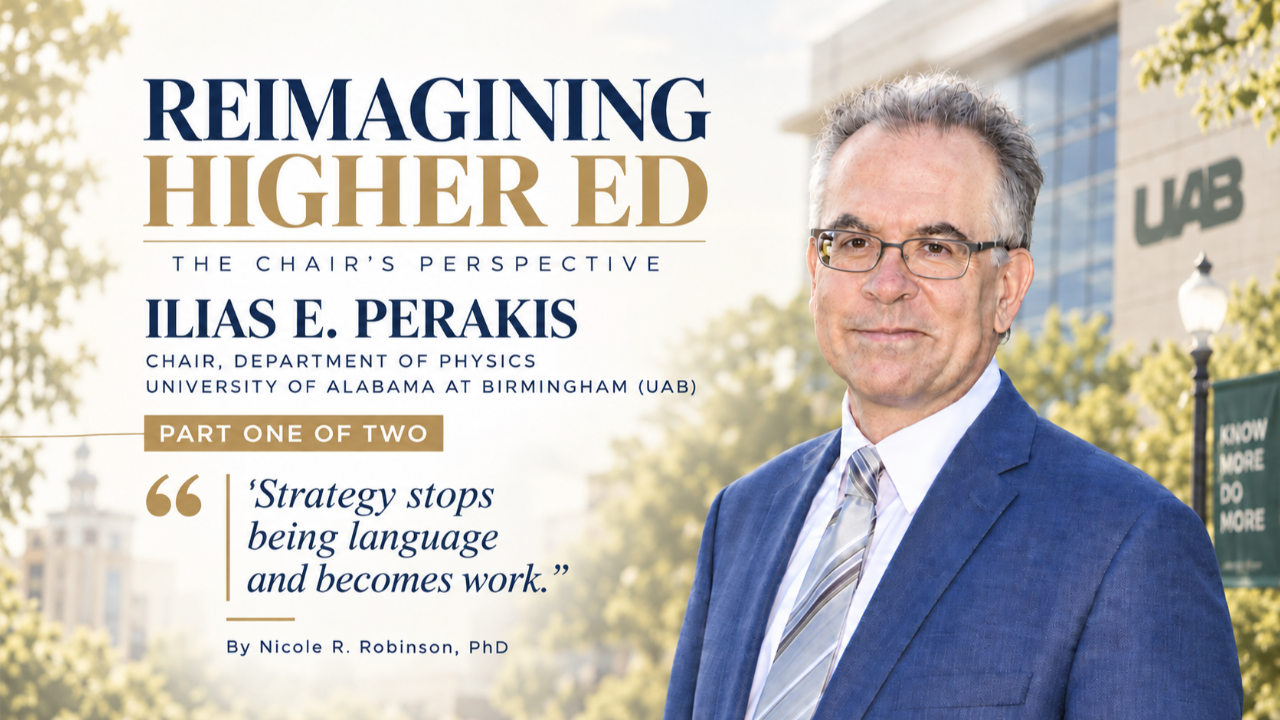
A Reimagining Higher Ed editorial informed by Ilias E. Perakis's written responses to Nicole R. Robinson
Ilias E. Perakis has spent more than three decades inside research universities in the United States and Europe, moving across scientific research, faculty life, interdisciplinary work, undergraduate education, and academic leadership. Since joining the University of Alabama at Birmingham in 2015, he has served as Professor and Chair of the Department of Physics. His earlier career included faculty and leadership roles at Vanderbilt University and the University of Crete, along with visiting appointments and research collaborations across major scientific institutions. His work has placed him inside questions of disciplinary identity, interdisciplinary research, student preparation, organizational leadership, and the practical realities of moving academic ideas into institutional practice.
That breadth of experience is one reason I was interested in Perakis’s perspective. But as I read his responses, the part that kept drawing my attention was not simply the range of institutions he has experienced or the scientific fields his work has touched. It was the vantage point from which he chose to make sense of the university: the department. Perakis describes the department as one of the most revealing places from which to start understanding higher education today because it sits close enough to faculty and students to see how decisions are actually experienced, while also carrying responsibility for translating broader institutional priorities into hiring, budgets, curricula, research priorities, student opportunities, and daily choices. In his words, it is a place where “strategy stops being language and becomes work.”
That framing immediately pushed me toward a different way of thinking about where institutional change actually becomes visible. Higher education often studies itself from the level where priorities are set, policies are written, and strategies are announced. Perakis’s perspective turns the institution around and asks what those same ambitions look like from the level where they have to be translated into actual work. From that vantage point, he offers a distinction that I think deserves much more attention: “Complexity is not the problem. Fragmentation is.”
Universities are complex because the work they exist to do is complex. Knowledge does not organize itself neatly. Disciplines have different histories, methods, vocabularies, and ways of determining what counts as evidence. Students arrive with different experiences, ambitions, and needs. Faculty bring different intellectual commitments. Institutions make decisions across competing priorities, distributed authority, finite resources, and multiple constituencies. Some of that complexity is not evidence that something has gone wrong. It may be evidence that universities contain exactly the kinds of differences they were designed to hold.
What Perakis’s distinction helped me see more clearly is that complexity and fragmentation are not interchangeable conditions. He describes faculty becoming disconnected from students, disciplines from one another, research from education, workforce preparation from the academic experience, and institutional strategy from the capacity, incentives, resources, or authority of the people expected to make it real. Fragmentation, then, is not simply the existence of many parts. It is what happens when those parts no longer connect strongly enough to accomplish something larger together.
That distinction changes the nature of the problem. If complexity is the problem, then the instinct is to simplify. If, however, fragmentation is the real problem, reimagining requires something different. It requires us to ask how the parts of the institution relate to one another, where those relationships have weakened, and what might become possible if connection were treated as institutional infrastructure rather than an incidental outcome.
The View from the Middle
Perakis refers to the department as a kind of “translation layer of the university,” the place where disciplinary identity meets institutional purpose and where institutional ambition encounters the reality of faculty work and student experience. I find that framing particularly useful because translation implies something more demanding than implementation. Translation requires understanding what is being asked at one level of an institution, interpreting what it means within another, and deciding how an idea must change as it moves from aspiration into practice.
An example from Perakis’s experience as chair where an institutional priority had to be translated, adapted, and ultimately rethought at the department level is the development of distance-accessible Physics at UAB. The institutional priority was to expand online education. But at the department level, the question could not simply be, “How do we put Physics online?” Physics depends on problem solving, interaction, laboratories, feedback, and students working through difficulty.
Rather than treating this primarily as a delivery-format problem, we approached it as a program-design problem. We asked how distance-accessible Physics could serve UAB’s health-focused mission while preserving academic rigor and improving the student experience. That required attention not only to technology, but also to online pedagogy, academic support, course quality, staffing, laboratories, and a resource model that aligned responsibility with the capacity to sustain quality.
The program grew from roughly 100 to more than 2,500 annual enrollments while D/F/withdrawal rates fell from more than 25 percent to below 10 percent. What began as an institutional aspiration to expand access therefore became a much larger question: How do we provide high-quality Physics education to students whose needs and academic pathways are not well served by the traditional model?
The resulting program serves students across Health Professions, Nursing, Public Health, Arts & Sciences, and other areas of the university. It went well beyond placing conventional Physics on a computer screen. We built a model around access, engagement, academic quality, and institutional mission. The courses subsequently earned Quality Matters certification and UAB recognition through the Provost’s Transformative Online Course Award. Translation sometimes requires changing the question before changing the program.
Higher education spends considerable time developing strategy at the institutional level. Universities identify priorities around student success, interdisciplinary research, artificial intelligence, workforce preparation, community engagement, enrollment, research growth, and any number of other goals. Those priorities matter, but Perakis’s responses kept forcing me to consider what happens after the priority has been named. Eventually, every institutional aspiration has to arrive somewhere. At some point, a strategic commitment becomes a course someone has to redesign, a curriculum someone has to revise, a position someone has to fund, a partnership someone has to maintain, a research collaboration someone has to initiate, or a student someone has to support differently.
The department makes that translation visible. From the level at which strategy is written, a priority may appear singular and coherent. From the department, that same priority arrives alongside every other institutional expectation already competing for the same people, time, attention, and resources. Perakis puts the practical questions plainly: Who will do the work? What will they stop doing? What resources do they have? Does the faculty understand why this matters? Do people have enough authority to act? What happens when the first attempt fails?
Those may sound like operational questions, but his response pushed me to see them as institutional questions. A university can announce that interdisciplinary work matters, but eventually someone has to create the conditions under which people from different disciplines can actually work together. An institution can prioritize student success, but at some point that commitment has to alter something about the student’s lived experience. A strategic plan can identify workforce preparation as an institutional priority, but faculty, curriculum, advising, experiential learning, employers, and students eventually have to become connected in ways that make the aspiration real.
From the chair’s vantage point, strategy is no longer an abstraction. It becomes capacity, workload, authority, resources, and human judgment. That is why the department matters as a site of institutional interpretation. It can reveal whether a priority has truly been designed for implementation or whether the institution has simply moved an aspiration down the organizational chart and assumed that the remaining work will somehow organize itself.
When Good Ideas Are Not Enough
One of the more revealing parts of Perakis’s responses is his willingness to describe how his own understanding of leadership has changed. Earlier in his career, he says, he placed too much faith in good ideas. If the right strategy could be identified, the intellectual case made persuasively, and a sound plan developed, he assumed progress would follow. He no longer believes that.
That admission stayed with me because universities rarely suffer from a shortage of intelligent people or worthwhile ideas. Higher education produces strategic plans, task force reports, committee recommendations, pilots, centers, partnerships, programs, and initiatives with remarkable regularity. Faculty generate ideas. Leaders generate ideas. Students generate ideas. Institutions can be full of ideas and still struggle to change.
Perakis’s reflection pushed the question beyond whether institutions know what they want to do and toward whether they have created the conditions through which an idea can become someone’s work. He argues that a leader can announce a priority, but someone must eventually believe in it, take responsibility for it, adapt it to local circumstances, solve the problems that emerge, and sustain it after the initial enthusiasm has faded. People need clarity about purpose, meaningful authority, high expectations, honest feedback, adequate support, and room to exercise judgment.
His own evolution as a leader is captured in one line: “When I care most, I listen longer and control less.” There is something counterintuitive in that statement. When leaders care deeply about an outcome, control can feel responsible. The stakes are high, the direction may seem clear, and time may feel limited. The instinct can be to narrow the path, provide the answer, and move people toward it.
One of the experiences that changed Perakis’s understanding of leadership came when he was brought in from outside to lead Materials Science and Engineering at the University of Crete. The department was deeply divided. Faculty meetings could last an entire day without producing decisions. A serious faculty dispute had reached the courts, junior faculty felt pressure to align with one side or the other, hiring had stalled, and the university was questioning the department’s viability.
Perakis recalls this experience: “I arrived thinking that the central problem was paralysis: the department needed to make decisions again. Because I was an outsider, my instinct could easily have been to establish direction quickly and move the stalled work forward.
“But I listened first. I met individually with faculty, spent time in their laboratories, and talked with people across the different groups, particularly junior faculty caught between the competing factions. What I heard changed my diagnosis. The problem was not simply that people disagreed or could not make decisions. They no longer trusted the process by which decisions were made.
“That required a different response. Before faculty meetings, I circulated the issues to be decided and invited written arguments. I also put my own reasoning and recommendations in writing, including the evidence behind them. Some colleagues thought that was risky in an environment where disputes had already reached the courts. I believed the greater risk was continuing to make decisions in ways people could not understand or trust.”
Not everyone agreed with every decision, and consensus was never the objective. What mattered was that people knew they had been heard, that the same rules applied to everyone, and that decisions had a visible rationale.
Gradually, the department began making decisions again. Hiring restarted. They addressed long-standing infrastructure problems and secured university approval for building space the department had unsuccessfully sought for years. Just as important, the department began to see itself again through its academic contributions rather than primarily through its internal conflict.
This experience taught Perakis something he has carried ever since: in a divided organization, people do not necessarily need consensus before they can move forward. They need confidence that disagreement will be handled fairly. That meant learning to listen privately, reason explicitly, and decide transparently.
Years later at UAB Physics, Perakis encountered a very different department but a related leadership challenge. The visible problem was program viability and declining degree and credit hour production. His approach was: Listen long enough to understand. Decide before deliberation becomes drift. Listening helped him understand that faculty resistance to some proposed changes was not simply resistance to change; people were protecting the research identity and intellectual depth of Physics.
That changed the question from “How do we increase enrollment?” to “What should a strong Physics department at an urban, health-focused R1 university become for the twenty-first century?” They put that question into a faculty-led planning process rather than beginning with a predetermined answer. The lesson was the same: people are more willing to change when they trust that change will strengthen rather than erase what they value.
What I find compelling in Perakis’s response is that he is not describing a retreat from responsibility. He is describing a different understanding of it. Listening longer, in his framing, does not mean reducing expectations or avoiding difficult decisions. It means creating enough room for other people to exercise judgment, develop ownership, and become capable of carrying the work themselves. His role was to make the process clearer and fairer, not to predetermine what people were allowed to contribute to it.
That shifts the measure of leadership. Perakis asks whether faculty gained the confidence and opportunity to lead something they could not have led before, whether students left with greater capability and a wider sense of what they could become, and whether the department became less dependent on the person sitting in the chair. I find that last question particularly consequential because higher education often recognizes leaders for what they personally build: the program, the center, the initiative, the partnership, the growth. But there may be another measure of leadership that matters just as much: whether the organization becomes more capable because the leader was there, rather than more dependent on the leader remaining there.
That is where Perakis’s leadership reflection began pushing my thinking beyond leadership style and toward institutional capacity. A leader can accomplish a great deal and still leave an organization dependent on the leader. If that is true, then developing people is not peripheral to institutional change. It is part of the infrastructure through which change becomes sustainable.
One example is faculty mentoring. At UAB Physics, Perakis recruited a large fraction of current faculty during his chairship. He says that he could have made mentoring primarily a chair-to-faculty relationship. Instead, he created a facilitated peer-mentoring structure so that early-career faculty could learn from one another, receive candid feedback, build collaborations, and develop a professional community that did not depend entirely on the chair.
Over time, those relationships became part of the department’s culture rather than an initiative that had to be driven from the chair’s office. Faculty began supporting one another, sharing experience, and developing confidence as independent scholars and colleagues.
That reflects what he means by institutional capacity. If every important relationship runs through the leader, the organization may look strong while the leader is there but still remain fragile. He would rather build relationships, judgment, and leadership capacity that survive him.
When Strategy Becomes Capacity
Perakis’s view from the department complicates the way we often talk about institutional strategy. Strategy is not complete when the priority has been named, the plan approved, or the direction communicated. Eventually, it has to become work that people understand, have the capacity to carry, and can continue carrying without every decision or relationship depending on the person who first set it in motion.
That may be one of the most useful things the department allows us to see. From the middle of the institution, the distance between aspiration and implementation becomes visible. So do the conditions that either help close that distance or quietly widen it: trust, authority, workload, resources, relationships, judgment, and the capacity of people to carry responsibility themselves.
Perhaps the question is not only whether an institution has a strategy. It is whether the institution has built the conditions through which that strategy can become someone’s work.
But capacity alone does not resolve the larger question Perakis raises. Universities contain disciplines, departments, programs, research, teaching, student experiences, and communities that are meant to remain distinct in important ways. If fragmentation is the problem, how do we strengthen connection without erasing the differences worth preserving?
That is where Part Two begins.
Part Two: Connect What Benefits From Connection — coming soon.
About Ilias E. Perakis
Ilias E. Perakis, PhD, is Professor and Chair of the Department of Physics at the University of Alabama at Birmingham. He joined UAB in 2015 and is a Fellow of the Optical Society of America, now OPTICA, recognized for contributions to the many-body theory of the coherent optical properties of semiconductors and metals. His academic career has included faculty and leadership roles at Vanderbilt University and the University of Crete, as well as visiting appointments and research collaborations in the United States and Europe. His research has been supported by the National Science Foundation, the U.S. Department of Energy Basic Energy Sciences, and the European Union.
What Would We Build Again?
After more than thirty years in higher education, Perakis describes his work in three phrases: “Build People. Connect Knowledge. Create Public Value.” What strikes me is that each of those aspirations depends upon relationship. Building people requires connection among expectation, authority, opportunity, support, accountability, and trust. Connecting knowledge requires disciplinary depth strong enough to be able to contribute something meaningful, together with institutional pathways that allow that knowledge to encounter something beyond itself. Creating public value requires a relationship between what universities know, what they teach, what they discover, and the people and communities whose lives that knowledge might affect.
None of those things happens through declaration alone, and perhaps that is what Perakis’s view from the department allows us to see particularly clearly. A university can appear integrated from the top while feeling fragmented from the middle. A strategy can read coherently in a planning document while reaching departments as a series of separate demands competing for the same people and resources. A student can belong to one institution while experiencing a collection of courses, offices, opportunities, and expectations that never quite become a whole. A university can contain extraordinary expertise while creating too few pathways for that expertise to encounter itself.
None of those conditions requires the university to become less complex. They require it to become more connected.
That brings me back to the distinction that first caught my attention in Perakis’s responses. If institutions mistake fragmentation for complexity, they may spend enormous energy simplifying structures when the deeper need is to strengthen the relationships among them. They may centralize when they should connect, standardize when they should translate, add another initiative when they should understand why the existing pieces are not working together, or ask individuals to collaborate more without examining whether the institution has created the conditions through which meaningful collaboration becomes possible. While centralization, standardization, or a new initiative can each be the right answer, the point is that diagnosis should precede the remedy.
Perakis ends his reflections with a question: “If we were designing a university today around the people we serve, the knowledge we seek to create, and the public value we hope to produce, which parts of the institution we inherited would we deliberately build again, and which would we build differently?”
His question takes us directly into the work of reimagining higher education, but his earlier reflections lead me to add another: Among the parts we would build again, how differently might we connect them?
Perakis would build strong academic departments again. Disciplines remain one of the most effective ways universities create intellectual depth, scholarly community, mentorship, identity, and a home for developing expertise. He would not abandon that structure simply because many of today’s most consequential problems are interdisciplinary.
What he would reimagine is how the college connects those departments. As he puts it, strong departments create depth; a strong college creates the connections that allow that depth to become something larger.
Those connections, however, need to be designed rather than left to chance. Many colleges are still organized primarily to administer disciplines vertically, while emerging challenges, from AI and health to sustainability, data, and workforce transformation, increasingly require disciplines to work horizontally as well.
Perakis therefore sees the college less as a collection of units reporting upward and more as a team of teams: strong departments with meaningful autonomy and accountability, connected by shared purpose, trusted relationships, transparent information, and opportunities to build together. In that model, the dean’s role is not to centralize the expertise that lives in departments, but to create the conditions that allow that expertise to find one another, align around consequential problems, and act collectively when connection creates value.
If he could reconnect one part of the university first, Perakis would begin by linking undergraduate education more intentionally with research and real-world learning.
Students should encounter knowledge not only as something already discovered and presented to them, but as something they can participate in creating and applying. Research and real-world learning develop judgment, resilience, curiosity, collaboration, and the ability to work on questions for which the answer is not already known, capabilities that become more important as AI makes information and routine analytical work increasingly abundant.
At UAB Physics, initiatives such as Building Futures in Birmingham and the Magic City Data Collective extend that principle beyond a single course or department by connecting mentoring, research, community problems, experiential learning, city as a classroom, and opportunity rather than leaving students to assemble those experiences on their own.
The larger goal is not to erase the university’s parts, but to make those parts capable of doing more together.
Perhaps the university of the future does not require fewer disciplines, fewer ideas, fewer ambitions, or fewer differences. Perhaps it requires an institution more capable of allowing those differences to become something together without erasing what makes them valuable in the first place.
That is a very different project from simplifying higher education. It is the harder work of building coherence without demanding sameness, preserving depth without accepting isolation, and ensuring that institutional ambition remains connected to the people who eventually have to make it real.
Complexity may be inherent to higher education. Fragmentation does not have to be.
About Ilias E. Perakis
Ilias E. Perakis, PhD, is Professor and Chair of the Department of Physics at the University of Alabama at Birmingham. He joined UAB in 2015 and is a Fellow of the Optical Society of America, now OPTICA, recognized for contributions to the many-body theory of the coherent optical properties of semiconductors and metals. His academic career has included faculty and leadership roles at Vanderbilt University and the University of Crete, as well as visiting appointments and research collaborations in the United States and Europe. His research has been supported by the National Science Foundation, the U.S. Department of Energy Basic Energy Sciences, and the European Union.
About Reimagining Higher Ed: The Chair’s Perspective
The Chair’s Perspective is part of Reimagine Higher Ed’s ongoing inquiry into what higher education must understand, preserve, reconsider, and build for what comes next. Each editorial begins with the experiences and reflections of a department chair, then examines the larger institutional questions their perspective brings into view.