The Slow Work of Meaningful Change
What John W. Scheib’s reflections on institutional change reveal about what reimagining higher education actually requires
Based on written reflections and a conversation with John W. Scheib.
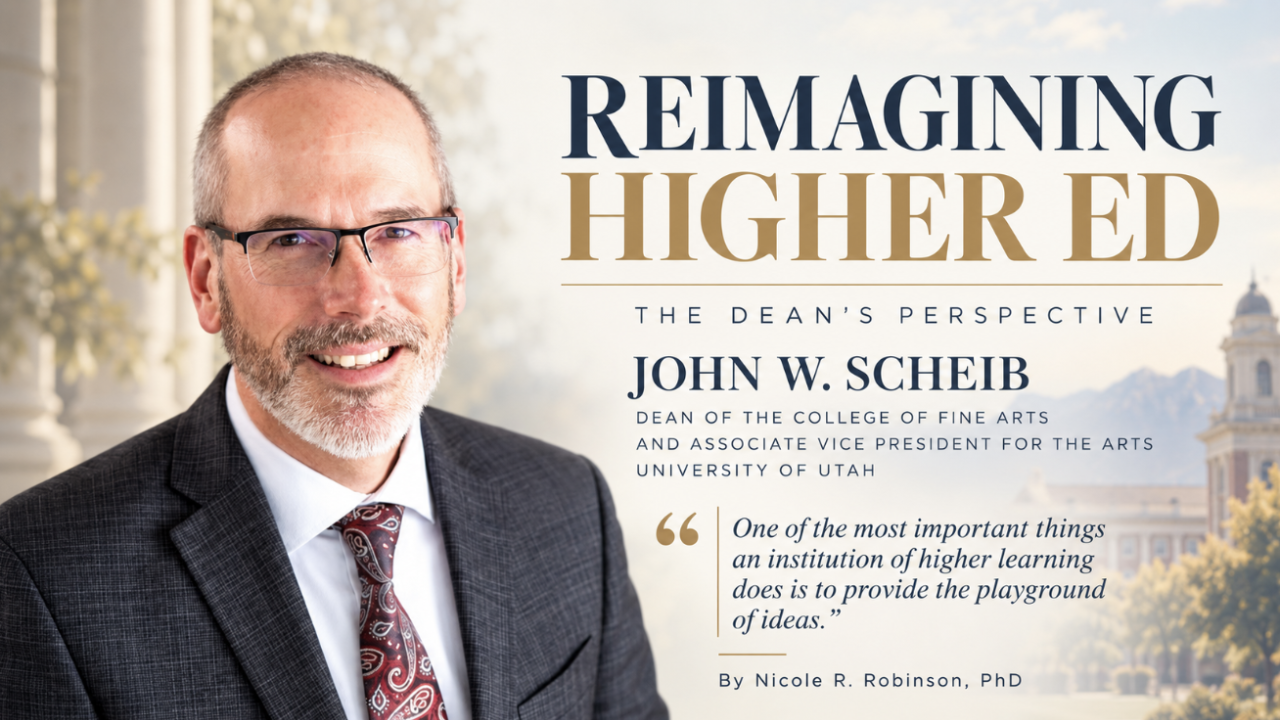
John W. Scheib has spent much of his higher education career leading change from inside institutions. As Dean of the University of Utah’s College of Fine Arts and Associate Vice President for the Arts, he leads a college of more than 2,000 students and 300 faculty and staff across five academic units. Since arriving at Utah in 2017, his leadership has included strategic planning, the development of new academic programs, significant curricular and licensure restructuring, international partnerships, expanded arts infrastructure, and a capital campaign of more than $35 million. His earlier administrative work at the University of Kentucky and Ball State University similarly placed him inside questions of curriculum, policy, assessment, accreditation, budgeting, fundraising, and organizational change.
In his role as Associate Vice President for the Arts, Scheib’s portfolio also includes oversight of four professional arts affiliates: Pioneer Theatre Company, the University’s professional regional theatre in residence; Tanner Dance, a youth arts program; the Utah Museum of Fine Arts, the state’s fine arts museum; and Utah Presents, the University’s performing arts presenting organization.
That breadth of experience is precisely why I was interested in Scheib’s perspective on reimagining higher education. He has not spent his career simply observing institutions or proposing what they should do differently. He has worked within the structures higher education has inherited, led efforts to change some of those structures, and experienced firsthand what happens between recognizing that something needs to change and actually changing it.
As I read his responses, one tension kept pulling my attention.
Scheib is candid about the bureaucratic and institutional forces that can make change difficult. Yet when I asked where leaders most often underestimate what it takes to move from intention to implementation, his answer was not that higher education simply needs to move faster.
Instead, he argued for something slower: socialization.
“It takes planting seeds of ideas early, working with stakeholders over some time on the development of these ideas into actionable initiatives.”
That distinction made me pause because it complicates one of the most familiar critiques of higher education: institutions are too slow to change.
Perhaps slowness itself is not the problem.
Perhaps we have not been careful enough about distinguishing between time consumed by institutional friction and time invested in creating the conditions through which meaningful change can actually take hold.
When Slow Means Something Different
Scheib describes socialization as the “oftentimes slow and steady work” of bringing an idea or initiative to a sufficiently ripened state before implementation. It requires time, energy, strategy, and engagement with the people who will eventually have to make the idea real.
What interested me most was his contrast between that work and what he describes as the more familiar practice of “selling” ideas that have already been developed from the top.
Institutions know how to communicate.
A direction is established. An initiative is developed. Messages are prepared. Leaders explain what is changing, why it matters, and what people are expected to do next.
But communication and socialization are not necessarily the same thing.
Scheib’s response made me wonder whether we sometimes locate the beginning of implementation too late. We tend to imagine implementation as the stage that follows strategy. First we decide. Then we implement.
What if implementation begins while the idea itself is still being formed?
For Scheib, that earlier beginning is relational. It means building authentic relationships at the ground level of an idea, before positions have hardened and before people are being asked simply to respond to something that has already been decided. Those relationships require trust, honesty, and reciprocity. They create the conditions for people to speak candidly about what they see, what concerns them, what they understand differently, and what leaders themselves may not yet have considered.
The purpose is not merely to gather feedback as a final checkpoint. It is to create genuine opportunities for the people closest to the work to help shape how an emerging idea is understood and developed. In that sense, socialization is also a form of stakeholder building. People are not simply being prepared to receive an initiative. Through relationship and meaningful exchange, they may begin to understand its possibilities, test its assumptions, influence its direction, and locate themselves within what is taking shape.
If the people responsible for carrying an initiative encounter it only after its major assumptions have been settled, then some of what leaders later experience as resistance may have begun much earlier as distance. People may understand the message without having had any meaningful opportunity to wrestle with the idea, influence its development, test its implications, or imagine themselves inside what comes next.
That does not mean every decision requires consensus. Nor does it mean an institution can deliberate indefinitely.
It means that readiness may require more than announcement.
Scheib uses the language of an idea becoming “ripened.” I find that word particularly useful because ripening suggests something that cannot simply be demanded at the moment we need it. Conditions have to be created. Time has to do some of the work.
But this does not mean that every part of institutional change should move slowly. Our conversation surfaced a more complicated tension. Some decisions, opportunities, and institutional pressures may require leaders to move with real urgency. At the same time, the relational work that makes movement possible often cannot be compressed in the same way. Trust, credibility, and authentic relationships are built over time.
The apparent tension between speed and relationship, however, may be less straightforward than it first appears. Investing time early in building trust can make later movement more fluid because people understand the context, have had opportunities to shape the thinking, and have greater confidence in both the process and the people leading it. What initially feels slower may ultimately allow an institution to move with greater clarity and less friction.
The reverse may also be true. Moving quickly past the relational work can create distance that surfaces later, when implementation depends on people who were never meaningfully brought into the development of the idea. What appeared efficient at the beginning may require considerably more time later to rebuild trust, revisit assumptions, or address concerns that might have emerged earlier.
The leadership question, then, becomes more complicated than whether an institution is moving fast enough.
Perhaps the more useful question is not simply how quickly we are moving, but where urgency is required and where time is an investment in our ability to move well.
When is time preventing change, and when is time preparing an institution to sustain it?
The Difference Between Friction and Deliberation
This is where Scheib’s responses became especially interesting to me.
In one answer, he describes bureaucratic dynamics and institutional forces that can make necessary changes in policy, operations, processes, and curriculum extraordinarily difficult. In another, he argues that leaders must be willing to invest considerable time in developing ideas with stakeholders before attempting to implement them.
Those positions are not contradictory.
But together they expose a distinction that I think matters for anyone serious about reimagining higher education.
There is institutional friction that consumes time without making an idea better, strengthening relationships, increasing understanding, or improving the institution’s capacity to act.
And there is deliberation that may also consume time, but changes what becomes possible when the institution eventually moves.
From the outside, both may look like slowness.
From inside leadership, they are fundamentally different conditions.
One depletes the institution’s capacity for change; the other may be building it.
That distinction also raises a harder question. Leaders have to determine which kind of slowness they are encountering while they are still inside it. The committee meeting, the consultation, the governance process, the request for more information, the faculty conversation, or the additional round of review may represent legitimate institutional intelligence. Or it may represent a process that has accumulated long after its usefulness disappeared.
Reimagining higher education therefore cannot simply mean eliminating process in the name of agility.
It may require becoming much more discerning about which processes create the conditions for consequential change and which merely make change harder to accomplish.
What Reimagining Must Preserve
Scheib’s willingness to question how higher education operates is paired with an equally strong conviction about what higher education is for.
“One of the most important things an institution of higher learning does,” he writes, “is to provide the playground of ideas.”
His phrase stayed with me.
A playground of ideas is not a place where everyone arrives at the same conclusion. It is a place where perceptions, beliefs, facts, experiences, assumptions, and understandings encounter one another. Some survive that encounter. Others become more complicated. Some may need to be abandoned entirely.
Scheib sees that conflict as essential.
“This conflict is essential to be able to grow and evolve as human beings.”
That conviction also helps explain his concern about reducing higher education primarily to vocational preparation.
There is an understandable urgency behind questions about employment, return on investment, affordability, and the relationship between education and economic opportunity. Students and families should be able to ask what an education makes possible in their lives.
But Scheib’s responses pushed me toward another question.
What happens when the value of higher education becomes defined too narrowly, particularly around what it produces for the individual and how effectively it prepares that individual for work?
When I asked what higher education should be careful not to lose as we reimagine its future, Scheib returned to what he described as its role in “the betterment of society.” His reflections point toward a broader understanding of higher education’s purpose, one in which preparation for occupational life matters, but sits within a larger aspiration for what education might make possible in an individual’s life.
Scheib hopes higher education is preparing people not only for work, but for fulfilling lives in which occupational life is important without necessarily defining the whole. In that sense, his comments invite a more expansive consideration of the relationship between higher education’s individual and societal purposes, rather than treating them as competing aims.
That broader understanding of purpose also raises another question: how tightly should the purposes of higher education be bound to the structures through which institutions have traditionally pursued them?
Purpose Is Not the Same as Structure
This is where I think Scheib’s responses become most consequential.
He argues strongly for preserving higher education’s larger social and intellectual purposes. Yet when I asked what we might need to be willing to examine if we were truly reimagining higher education rather than simply improving the institutions we inherited, he turned toward some of its most familiar structures: teaching and learning, degree programs, curriculum, delivery, courses and schedules, credit, and time.
His question, fundamentally, is whether the structures around which higher education has organized itself for generations remain the most effective means of accomplishing the purposes we say matter.
One of the structures Scheib finds particularly interesting is also one of the most foundational: the credit hour. Academic progress has long been organized, at least in part, around time. Students enroll in courses of prescribed duration, move through them together, and accumulate the credits required for a degree.
Scheib’s question is not whether time, courses, or credit should simply disappear. It is whether demonstrated learning might play a larger role in how we think about academic progress, particularly in areas where the competencies required can be meaningfully identified and assessed.
That possibility changes the frame. If demonstrated competency played a larger role alongside time in some parts of a curriculum, students might not necessarily have to progress through every learning experience at precisely the same rate. Some might require additional time to develop particular knowledge or skills. Others might demonstrate competency sooner. And students who enter higher education with substantial professional experience, prior learning, or relevant expertise might have opportunities to demonstrate what they already know rather than beginning from the same point as someone encountering the material for the first time.
The larger question is not simply whether students can move faster. It is whether the structures we use to measure progress are sufficiently responsive to differences in what students already know, how they learn, and how long particular forms of learning actually require.
This is where the distinction between purpose and structure becomes important. We inherit a structure for so long that eventually it can begin to feel inseparable from the work itself. Yet a credit system, a course schedule, or a particular configuration of a degree is a way institutions have organized education. It is not necessarily the only possible expression of what education is intended to accomplish.
Some of those structures may continue to serve extraordinarily important purposes. Others may benefit from adaptation. And some may deserve closer examination precisely because they are so foundational that we rarely stop to ask what assumptions they carry.
Scheib’s professional experience makes that question particularly compelling. His leadership has included new academic programs, significant curricular revision, changes to credit requirements, strategic planning, policy development, accreditation, and other forms of institutional redesign across several universities. So when he asks whether our traditional approaches remain the most effective ways to accomplish our goals, he is not asking from outside the machinery. He has spent years inside it.
His question made me think about one of the distinctions that may matter most in any serious attempt to reimagine higher education:
Can we become more willing to separate what is essential to higher education from what has simply become familiar within higher education?
That is a different inquiry from simply introducing something new. Innovation can add another program, modality, technology, or pathway. Reimagination can require us to look beneath those additions and ask whether some of the structures we have inherited should themselves remain fixed.
Perhaps one of the most consequential places to begin is with something so familiar that we rarely notice how much of the enterprise has been built around it: time.
But institutions are not reconsidering these structures in isolation. They are doing so while expectations surrounding higher education, and questions about its value, are also changing.
Reimagining Amid Questions of Value and Trust
Scheib’s responses also place this inquiry inside a larger context.
He identifies public confidence and questions about how the value of higher education is understood as significant pressures facing institutions today. Those questions are unfolding alongside pressures related to funding, public expectations, workforce needs, affordability, and the broader environment in which colleges and universities operate.
What interests me most is not locating those pressures within any single explanation, but considering what they require of institutions attempting to reimagine themselves.
Higher education is being asked to reconsider aspects of how it operates at the same time that fundamental questions are being raised about what institutions are for, whom they serve, and how their value should be understood.
That matters.
Questions about funding, trust, cost, workforce preparation, public purpose, relevance, and institutional accountability are not separate from the work of reimagining higher education. They are part of the environment in which that work now takes place.
And that environment complicates the choices institutions face.
Questions about trust and value can invite institutions to examine how clearly they understand, communicate, and demonstrate their contribution. At the same time, responsiveness does not necessarily require narrowing the purposes of higher education to only those outcomes that are most easily measured. Scheib’s reflections point toward a more difficult task: remaining open to legitimate questions about the institution while maintaining clarity about the educational and societal purposes worth preserving.
The question underneath the question may therefore be this:
What kind of value does higher education believe it exists to create, and which dimensions of that value should remain essential even as the institution itself changes?
For Scheib, the question of what remains essential is no longer only institutional. As he prepares to conclude his deanship, it has also become a question of stewardship and succession.
What We Hand Forward
Scheib’s own leadership attention is currently focused on succession.
He is completing his tenth and final year as dean and is preparing for the search and transition to his successor. After taking some time away at the end of the academic year, he expects to return to the University of Utah in an associate provost role, shifting from the highly visible demands of executive leadership toward what he describes as more “behind-the-scenes” work.
The transition is intentional. At what he sees as a later stage of his career, Scheib is interested in engaging more deeply in strategic work that can be difficult to pursue while carrying the day-to-day responsibilities of a dean and senior arts leader. After years of being in the spotlight, he is looking forward to contributing from a different vantage point, one that may allow him to strengthen relationships, think across institutional boundaries, and spend more sustained time on work that requires depth.
But before that transition is complete, he is also thinking carefully about succession.
I am interested in that response because succession is not separate from the other questions Scheib raises throughout this conversation. In many ways, it brings them together.
A leadership transition requires a different kind of judgment. A departing leader has to consider what should be protected, what should be transferred, what remains unfinished, what relationships need attention, and what should intentionally be left open for the next person to shape.
Succession, then, is not simply the transfer of responsibility from one leader to another. It is also a decision about what gets handed forward.
What do we hand forward because it remains essential?
What do we hand forward because we simply inherited it ourselves?
And what should we intentionally leave open so that the people coming next have room to imagine something we could not?
Those questions extend beyond succession. They sit at the center of the larger challenge of reimagining higher education.
Reimagining is not simply an exercise in generating new ideas. It also requires the harder work of distinguishing.
And, in the context of succession, what deserves continuity from what should remain available for reconsideration.
Scheib’s reflections resist an easy choice between preservation and change. Instead, they suggest that leadership may require becoming much more precise about what deserves to endure, what needs continued cultivation, and what should be handed forward without being predetermined.
Perhaps succession is one of the clearest places where that responsibility becomes visible.
What Reimagining Requires
Taken together, Scheib’s reflections have made me less interested in reimagining as a search for what is newest and more interested in the judgment required to determine what should change, what should endure, and what conditions make either possible.
Across our conversation, the same tension appears in different forms. Time can become obstruction, or it can create the conditions for readiness. Process can generate friction, or it can deepen deliberation. A familiar structure can continue to serve an essential purpose, or it can become so embedded that we stop asking whether another form might serve that purpose differently. These are not choices institutions make once. They are judgments leaders have to keep making.
What connects many of those judgments is people. Scheib’s emphasis on socialization is a reminder that institutional change does not become real simply because a decision has been made or an initiative has been announced. It becomes real through relationships, trust, shared understanding, and opportunities for the people closest to the work to influence what eventually takes shape. That relational work may require more time at the beginning. It may also be precisely what allows an institution to move with greater clarity and less friction later.
His attention to succession brings that idea full circle. Reimagining is not only about what a leader changes during their own tenure. It is also about what that leader prepares others to inherit, what they help an institution understand about itself, and what they intentionally leave open for those who will come next.
Perhaps that is the deeper challenge Scheib’s reflections place before us. Reimagining higher education does not require treating everything we inherited as obsolete, nor everything familiar as essential. It requires becoming much more discerning about the difference.
And then doing the work necessary to act on what we discover.
The slow work of meaningful change, then, is not slowness for its own sake. It is the work of creating the conditions for institutions to move with greater clarity and purpose, and for meaningful change to endure.
About John W. Scheib
John W. Scheib, PhD, is Dean of the College of Fine Arts and Associate Vice President for the Arts at the University of Utah, where he also holds a faculty appointment as a tenured full professor in the School of Music. Before joining Utah in 2017, he served as Director of the School of Music at the University of Kentucky and previously spent twelve years at Ball State University in faculty and administrative roles, including four years as Director of its School of Music. His career spans academic leadership, curriculum and program development, strategic planning, accreditation, fundraising, arts advocacy, and scholarship focused in part on the multidimensional lives of artist teachers.
About The Dean’s Perspective
The Dean’s Perspective is a Reimagine Higher Ed editorial series examining what higher education must understand, preserve, reconsider, and build for what comes next. Each editorial begins with the experiences and reflections of a dean, then examines the larger institutional questions their perspective brings into view.