
What Rutgers University Libraries Teaches Us About Creating Shared Institutional Identity
Institutional Leadership Profile: Dr. Consuella Askew, Vice President for University Libraries and University Librarian, Rutgers University
Higher education is one of the most complex organizational environments in modern society.
Universities are often spoken about as though they are singular institutions. In practice, they are intricate systems of interconnected communities. Academic departments, colleges, administrative divisions, faculty governance, student affairs, research enterprises, libraries, alumni, and community partnerships all operate with distinct responsibilities, histories, and cultures while contributing to the mission of a single institution. Each understands the university from its own vantage point. Each experiences institutional life differently. Together, they create an institution whose complexity is not incidental to its work but embedded within it.
For many academic leaders, this complexity exists within a single organizational entity. A dean typically leads one college. A vice president oversees one division. A provost works to align the academic enterprise of one institution. Those responsibilities are significant, demanding, and consequential. Yet even within those organizational boundaries exists a remarkable degree of complexity. Every college, division, and academic unit contains its own cultures, informal networks, competing priorities, and embedded organizational dynamics that leaders must continually interpret and navigate.
Some executive leadership roles, however, require leaders to think beyond even those boundaries. They require leaders to cultivate coherence across multiple institutional cultures, geographically dispersed operations, and communities whose experiences of the same institution are both different and equally legitimate.
That was the leadership challenge my client, Dr. Consuella Askew, invited me to help her address in her role as Vice President for University Libraries and University Librarian at Rutgers University.
Rutgers University Libraries is not a single organizational entity. It is an integrated academic library system supporting one of the nation’s largest public research universities. Rutgers University encompasses four chancellor-led units, more than 71,000 students, over 23,000 faculty, researchers, clinicians, and staff, 29 schools, more than 150 undergraduate majors, and more than 400 graduate programs. Within that broader university enterprise, Rutgers University Libraries spans thirteen library facilities dispersed across New Jersey, stewarding more than six million physical and electronic resources, operating with annual expenditures exceeding $50 million, and supported by approximately 160 faculty and staff represented across six collective bargaining units.
The scale is impressive, but the organizational complexity represented by those numbers is even more consequential. Every campus serves different academic communities, different institutional priorities, and different local contexts. Every library contributes to a university that is both geographically dispersed and academically diverse. Together, they comprise one of the nation’s most significant public research library systems.
The leadership vision of Dr. Askew could be expressed in two words.
One Libraries.
The phrase is elegant in its simplicity. The work required to realize it was anything but.
For Dr. Askew, One Libraries was never simply an organizational aspiration. It was a commitment to ensuring that every student, faculty member, researcher, clinician, staff member, and community partner experienced the strength of the entire Rutgers University Libraries system, regardless of where they entered it. In Dr. Askew’s conception of One Libraries, geography or campus affiliation should never determine the quality of access available to a member of the Rutgers community. Every member of that community deserved equitable access to resources, expertise, services, and the collective knowledge of the institution.
Achieving that vision required considerably more than improving coordination among thirteen library facilities. It required the organization to begin thinking about itself differently. Individual libraries were no longer simply serving individual campuses. Together, they were stewards of a shared institutional mission that extended across the entire Rutgers community.
At first glance, this might appear to be primarily an organizational challenge, and organizational structure was certainly central to the work. Yet structure was never the destination. It was the methodology through which a deeper question of institutional identity could be addressed.
This was ultimately about helping Rutgers University Libraries define who it was as a unified academic enterprise. Organizational redesign mattered because it supported that identity, not because organizational charts alone create transformation. Structures can redistribute responsibility. They cannot, by themselves, create shared purpose. Before an institution can function as one, it must first understand what it means to become one.
It was this distinction that made the partnership so intellectually compelling for me. Beneath every conversation about organizational design was therefore a more enduring question: not simply How should the library be organized? but Who is Rutgers University Libraries becoming? That question shaped everything that followed.
From Many Experiences to One Institutional Understanding
The leadership vision of One Libraries established a clear institutional aspiration. What remained was the more difficult interpretive challenge of determining how thousands of distinct experiences of Rutgers University Libraries could be understood together as part of one institutional whole.
One of the first conversations Dr. Askew and I shared was not about organizational redesign, reporting relationships, governance structures, or implementation timelines. Instead, our conversation centered on a much more fundamental challenge: How do we create One Libraries from thousands of individual experiences of Rutgers University Libraries?
A student encounters Rutgers University Libraries through a different set of needs and expectations than a faculty member, researcher, librarian, staff member, clinician, or community partner. Campus location, professional role, disciplinary context, and purpose all shape how the institution is experienced. Every perspective is legitimate because every perspective reflects a particular relationship with the institution. Yet no single perspective is capable of defining Rutgers University Libraries as a whole.
One of the qualities I came to admire most about Dr. Askew was the intellectual curiosity with which she approached that complexity. She understood from the beginning that the vision of One Libraries could never be realized by asking one group to define the future for everyone else. If One Libraries was to become more than an aspirational phrase, it would have to emerge from a richer understanding of how the institution was experienced across its many communities. That required a process capable of bringing those experiences together, not to eliminate their differences, but to understand how they collectively revealed the institution itself.
Universities possess no shortage of information about themselves. They administer climate surveys, convene committees, conduct retreats, hold town halls, and produce strategic plans that often reflect years of institutional effort. Information, however, should not be mistaken for institutional understanding. The existence of data does not necessarily mean that an institution has developed the capacity to interpret what that data is collectively revealing.
Institutions have many ways of collecting information. They have far fewer ways of transforming thousands of individual experiences into one coherent institutional understanding.
That became the central methodological challenge of our partnership.
That interpretive work required an architecture capable of reaching beyond individual conversations. It was not possible to hear directly from every person who experienced Rutgers University Libraries. The challenge, therefore, was to design a process through which every part of the institution had a meaningful voice in shaping the institution’s future.
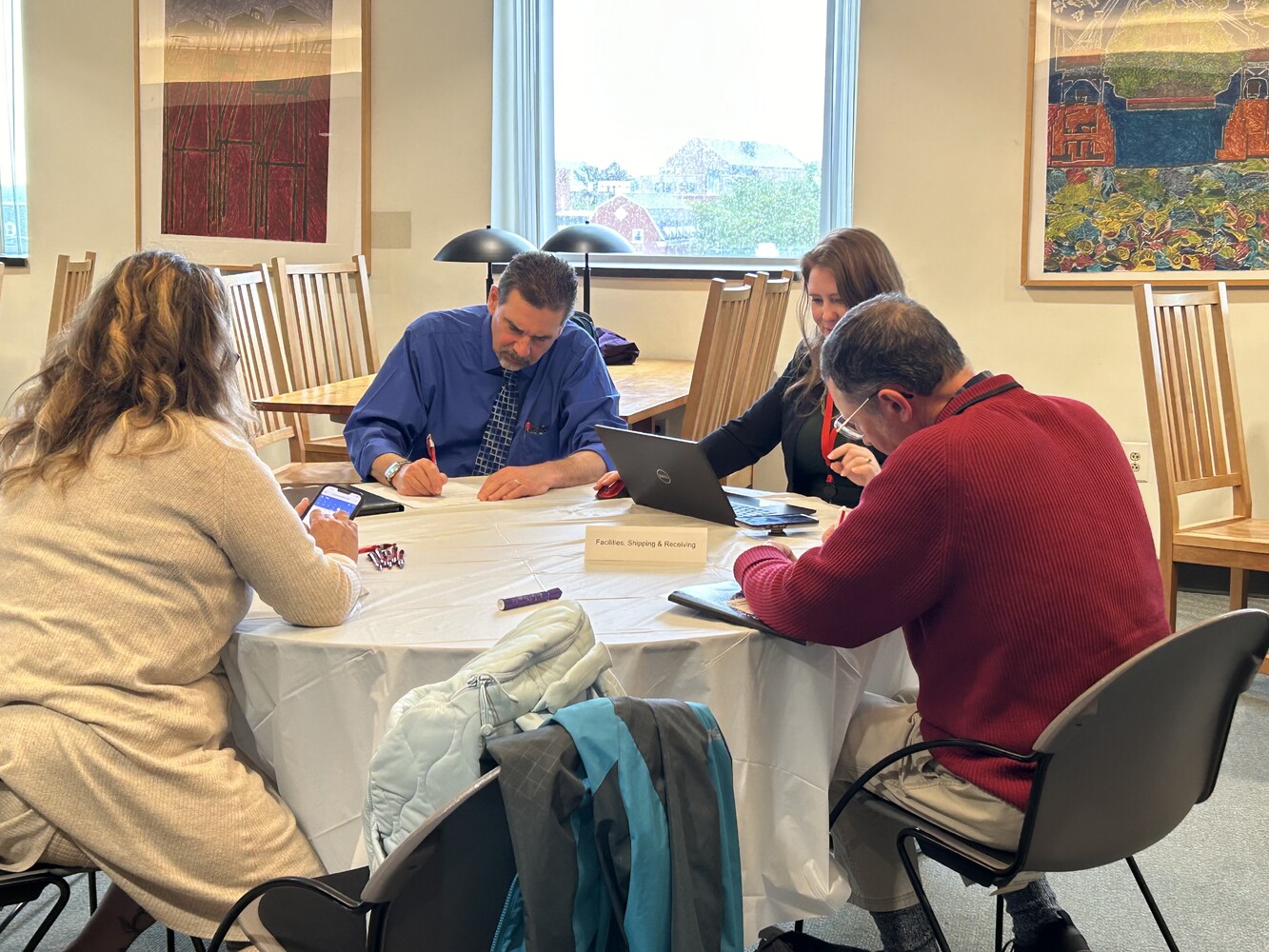 Rutgers University Libraries faculty and staff working together to interpret institutional conditions and identify emerging patterns.
At the center of that architecture was a thirty-member task force strategically constructed to represent the full organizational ecosystem of Rutgers University Libraries. Every major component of the organization was represented, with faculty and staff perspectives intentionally included across the system. The objective was not simply demographic representation. It was institutional representation. We wanted the institution itself to be present in the room through the people who collectively represented its many functions, roles, and lived realities.
The task force was never intended to function as a traditional committee charged with producing recommendations. It was designed as an interpretive body, helping us understand how the institution experienced itself across campuses, organizational functions, and professional roles. Members carried not only their own experiences into the process, but also the perspectives, questions, and observations of the communities they represented. In doing so, the task force became an essential bridge between individual experience and institutional understanding.
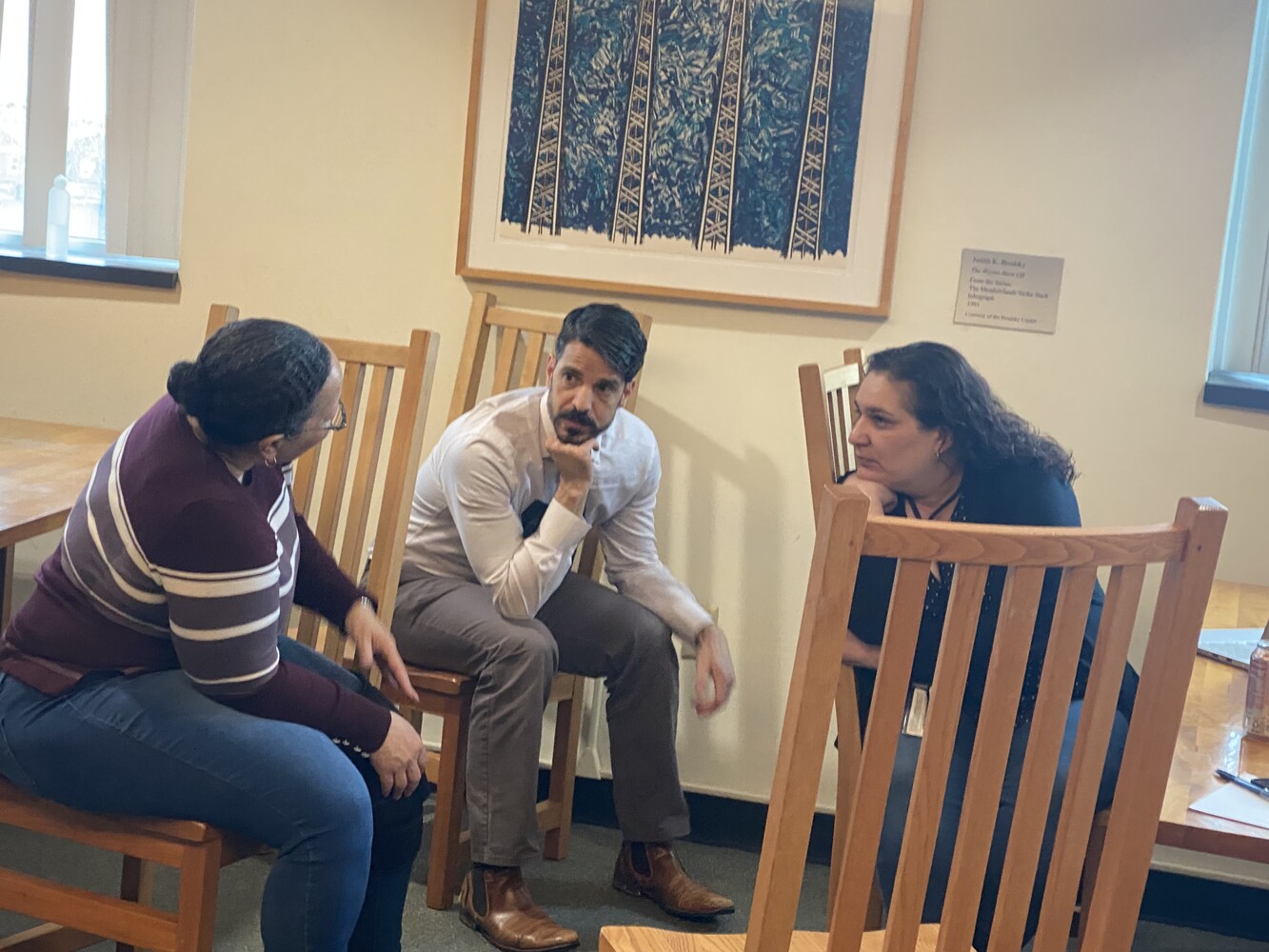 The task force leadership team brought together executive, faculty, and staff leadership, intentionally building different institutional perspectives into the work from the outset.
The task force also required a common interpretive language. Representation alone was insufficient if each member understood only the portion of the institution they encountered most directly. The challenge was to create a structure that allowed those local perspectives to remain intact while also making them legible as part of a much larger institutional picture.
It was within this context that the Four Ps became an essential part of the inquiry.
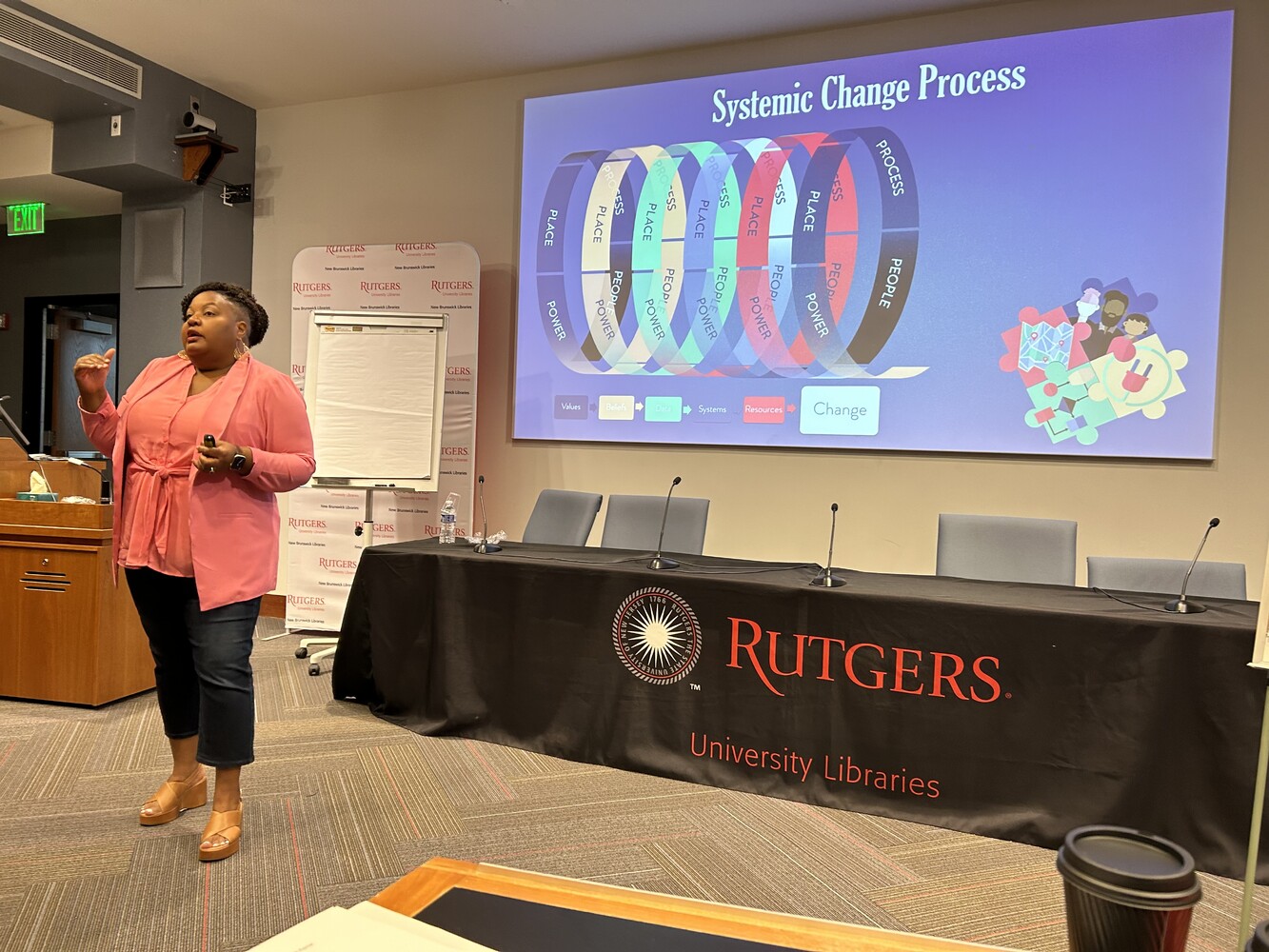 Dr. Nicole R. Robinson guiding the systemic change process using People, Place, Process, and Power as a shared interpretive framework.
Each member of the thirty-person task force was asked to map the component of Rutgers University Libraries they knew best through four interconnected dimensions: People, Place, Process, and Power. A task force member representing a specialized library, for example, did not attempt to describe the entire Rutgers system. That person mapped the people, places, processes, and power dynamics within the organizational environment they knew most intimately.
In this way, the larger Four Ps framework generated a series of more localized interpretive frameworks. Each area developed what might be understood as its own institutional sub-map, revealing the particular configuration of people, place, process, and power that shaped its experience within the larger system. These were not competing descriptions of Rutgers University Libraries. They were distinct expressions of institutional life, each illuminating a different part of the whole.
That distinction became especially important to our understanding of identity. If One Libraries represented the shared institutional identity Dr. Askew was working to cultivate, these localized Four Ps maps helped us see the sub-identities already living within it. A specialized library, an administrative unit, a service area, or a campus-based function could possess its own history, relationships, practices, and patterns while still belonging to a larger institutional enterprise. The objective was never to flatten those distinctions. It was to understand them well enough to see how they related to one another.
As the individual maps accumulated, we could begin to move between levels of analysis. We could examine the experience of a particular area, then step back and ask what became visible when that experience was considered alongside the experiences of other areas. Patterns that appeared local could be tested against the broader system. Differences could be understood rather than treated as inconsistencies. Connections that were difficult to see from within one unit became more apparent when the maps were placed in conversation with one another.
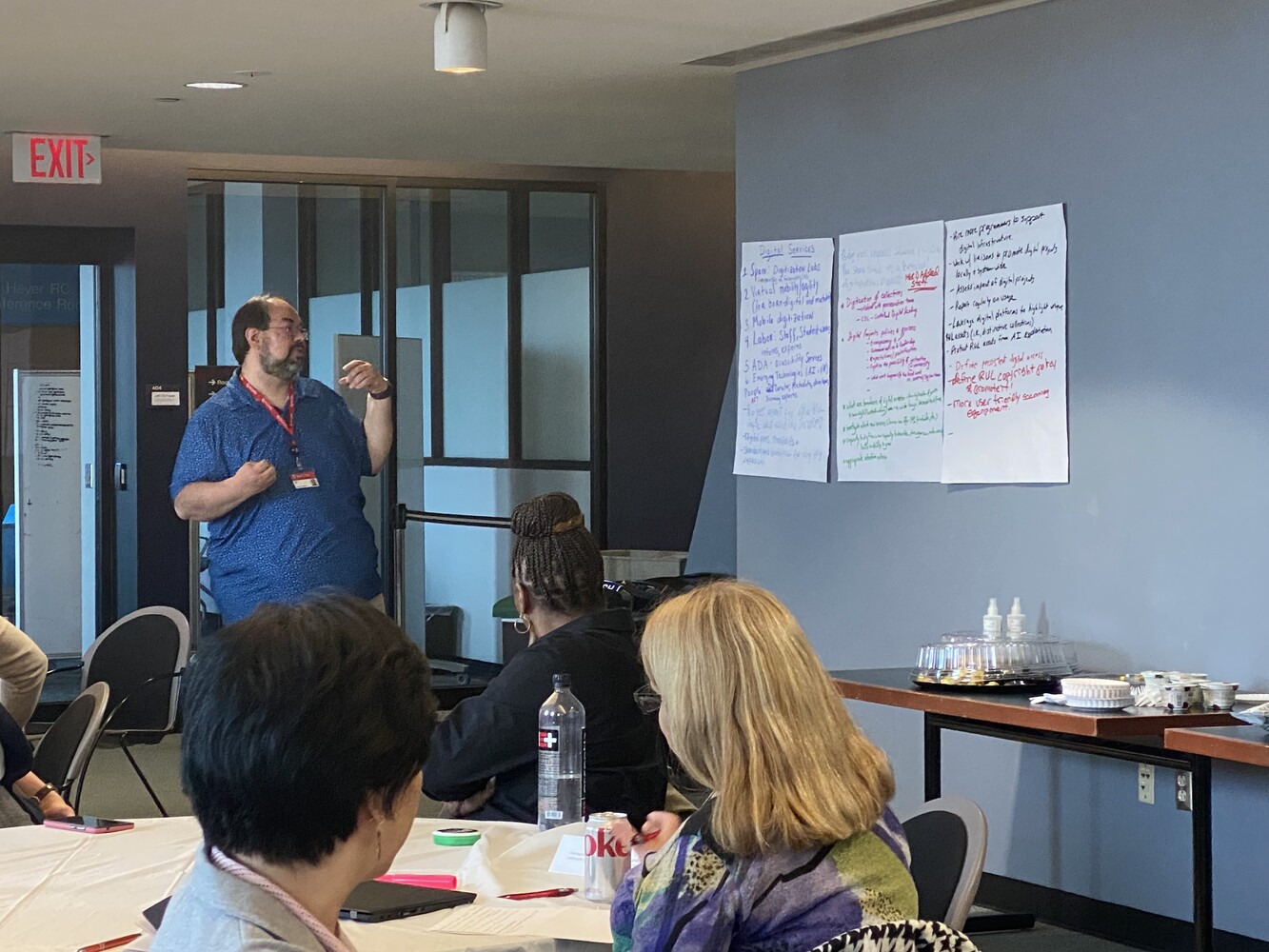 Task force members moving from small-group analysis to collective interpretation.
The Four Ps therefore became more than a framework for organizing information. They provided a shared interpretive structure through which the institution could hold both the particular and the whole at the same time. Each task force member could remain grounded in the part of Rutgers University Libraries they knew most deeply while contributing to a collective understanding of the larger system.
That is an important distinction in complex institutions. Shared identity does not require the disappearance of local identity. It requires a way of understanding how those local identities fit together, where they intersect, and what they collectively make possible.
When an Institution Begins to Hear Itself
There is a moment in meaningful institutional inquiry when individual observation begins to give way to institutional recognition. Nothing visible may have changed, yet something fundamental has begun to shift: the institution starts recognizing itself. The conversation changes as people who had previously understood the organization primarily from the vantage point of their own unit, campus, or professional role begin to recognize their experiences within the experiences of others.
What once appeared to be an isolated frustration may become part of a recurring institutional pattern. What seemed unique to one campus may appear elsewhere in the system. Individual observations begin to acquire meaning through their relationship to one another, and the institution develops a language for understanding itself that no single constituency could have produced alone.
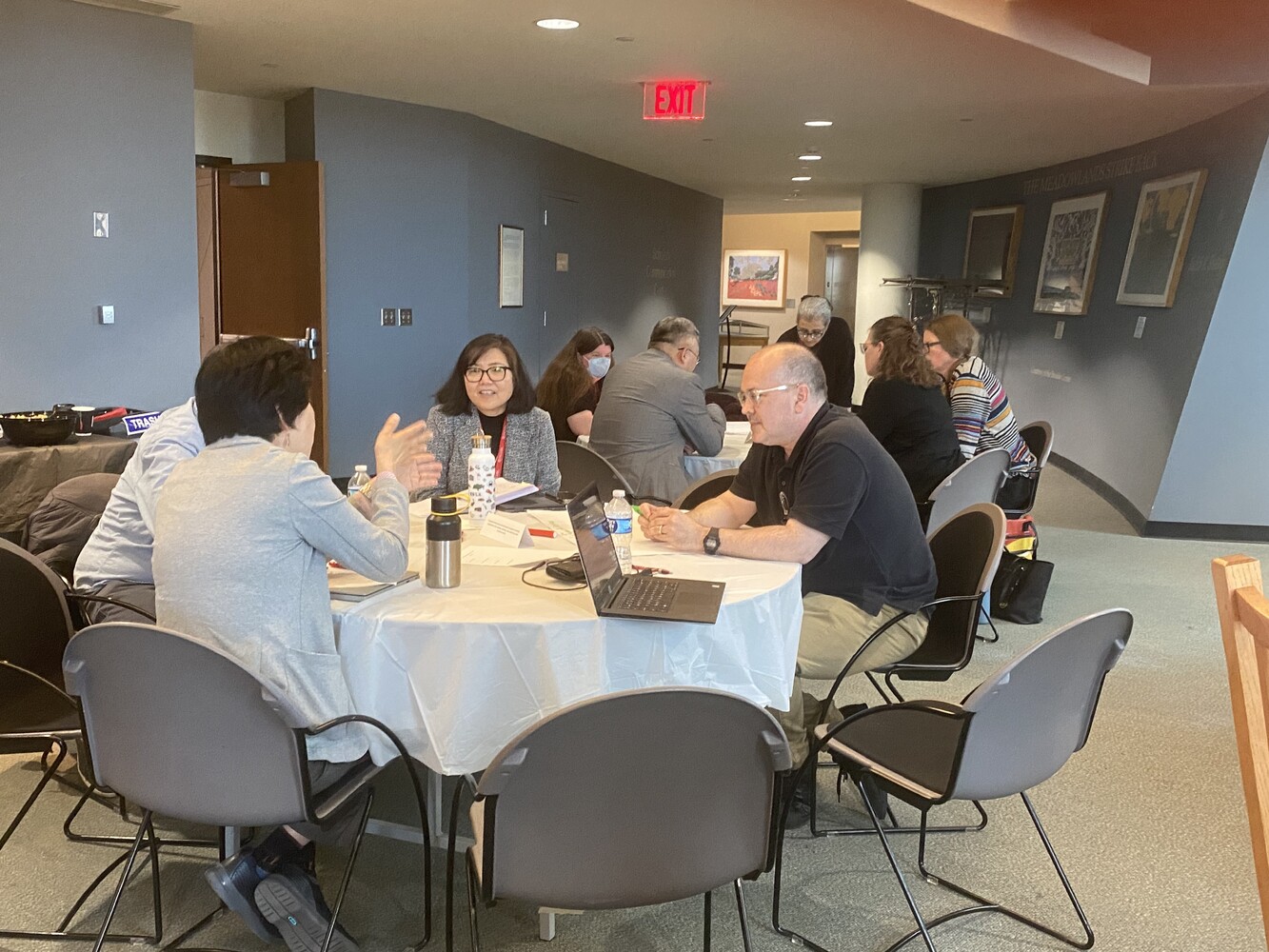 Faculty and staff from across Rutgers University Libraries participating in the institutional inquiry process.
The significance of that moment is not consensus. People may continue to disagree, sometimes substantially. What changes is the object of the disagreement: they are increasingly talking about the same institution from a more shared understanding of its conditions. Shared understanding does not eliminate difference. It makes difference more intelligible and therefore more useful to the work of institutional transformation.
This is what I witnessed through my partnership with Rutgers University Libraries. As the inquiry unfolded, the conversations became less about individual libraries and more about the identity of the library system as a whole. Faculty and staff continued to speak from the expertise of their own areas, but they also began recognizing how their work contributed to something larger than the organizational unit they represented. The task force no longer functioned simply as representatives of separate parts of the organization. They became stewards of a shared institutional future.
Looking back on the engagement, Dr. Askew reflected on one of the most important lessons she carried forward as a leader: “I learned to slow down and focus on the people, so my process was deliberately slow, inclusive, and iterative, ensuring that everyone across the library system had an opportunity to have a voice in the process.”
Her reflection captures, perhaps better than anything else, the kind of leadership this work required.
The pace of meaningful change is not determined solely by project timelines or implementation plans. It is determined by the pace at which an institution develops sufficient trust to understand itself honestly. Dr. Askew understood that institutional identity cannot simply be declared through organizational authority. It must be cultivated through the slower work of shared understanding, participation, and trust.
When that happens, organizational redesign begins to take on a different meaning. It is no longer leading the transformation. It is giving form to an identity the institution has already begun to discover.
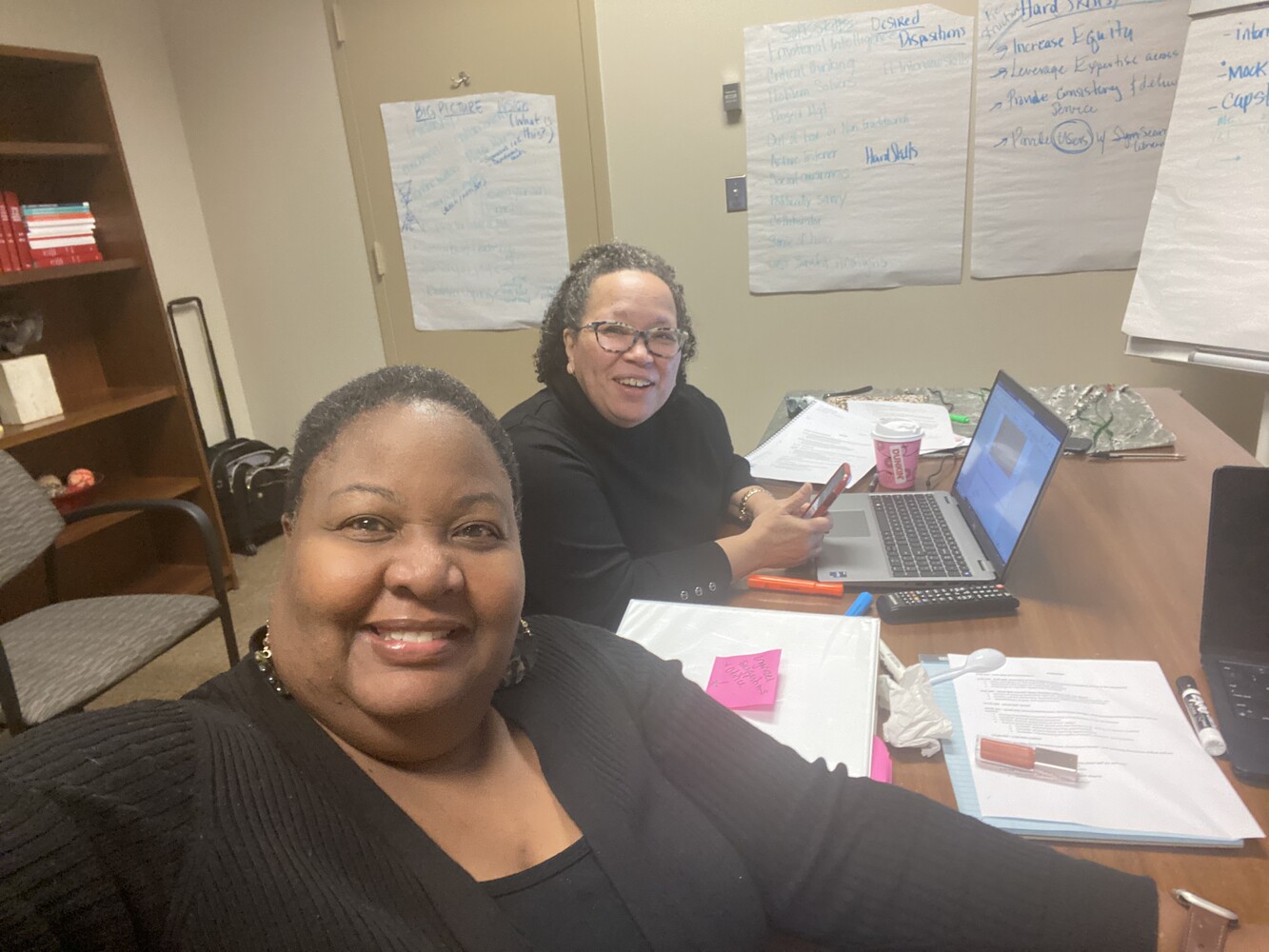 Dr. Consuella Askew and Dr. Nicole R. Robinson during their multi-year partnership advancing the One Libraries vision at Rutgers University Libraries.
Beyond Rutgers
Every institution eventually confronts some version of the question Dr. Askew faced at Rutgers. The scale and organizational configuration will differ, but the underlying challenge remains remarkably consistent: how does an institution develop a shared identity across people who experience it from different locations, roles, responsibilities, and histories?
Who are we becoming?
Too often, higher education attempts to answer that question through strategic plans, organizational redesign, or new initiatives. Those efforts are important. They provide direction, establish priorities, and clarify institutional aspirations. Yet institutional identity rarely emerges from aspiration alone. It develops through a sustained process of understanding how values, relationships, histories, practices, and experiences are already shaping institutional life.
That is why I continue to think about Rutgers University Libraries. Certainly because of the organizational transformation, and certainly because of the remarkable leadership demonstrated by Dr. Consuella Askew, but even more because the engagement reminded me of something I believe is true of every institution.
Institutions are constantly communicating.
They communicate through the experiences of students navigating the university, faculty advancing teaching and scholarship, researchers pursuing discovery, professional staff sustaining institutional life, and communities interacting with the institution from beyond its formal boundaries. They communicate through informal practices, recurring tensions, quiet successes, relationships, assumptions, and deeply held commitments that may never appear in a strategic plan yet profoundly shape how the institution functions.
The question has never been whether institutions are communicating.
The question is whether we, as leaders, have developed the tools and interpretive practices necessary to understand what our institutions are communicating.
One of the enduring strengths of Dr. Askew’s leadership was her willingness to lead from a place of inquiry, inclusion, and deep regard for the people who experienced the institution every day. Her vision of One Libraries was never reduced to a slogan or an organizational objective. It became an invitation for Rutgers University Libraries to understand itself more deeply, to recognize itself more fully, and ultimately to shape an institutional identity worthy of the community it served.
Perhaps that is among the most consequential responsibilities of institutional leadership: not merely designing better organizations, but creating the conditions through which institutions can understand themselves deeply enough to build the futures they are uniquely positioned to create.