Where Strategy Becomes Work | Ilias E. Perakis, University of Alabama at Birmingham | Pt 1
What Ilias E. Perakis's view from the department reveals about turning institutional ambition into work people can actually carry.
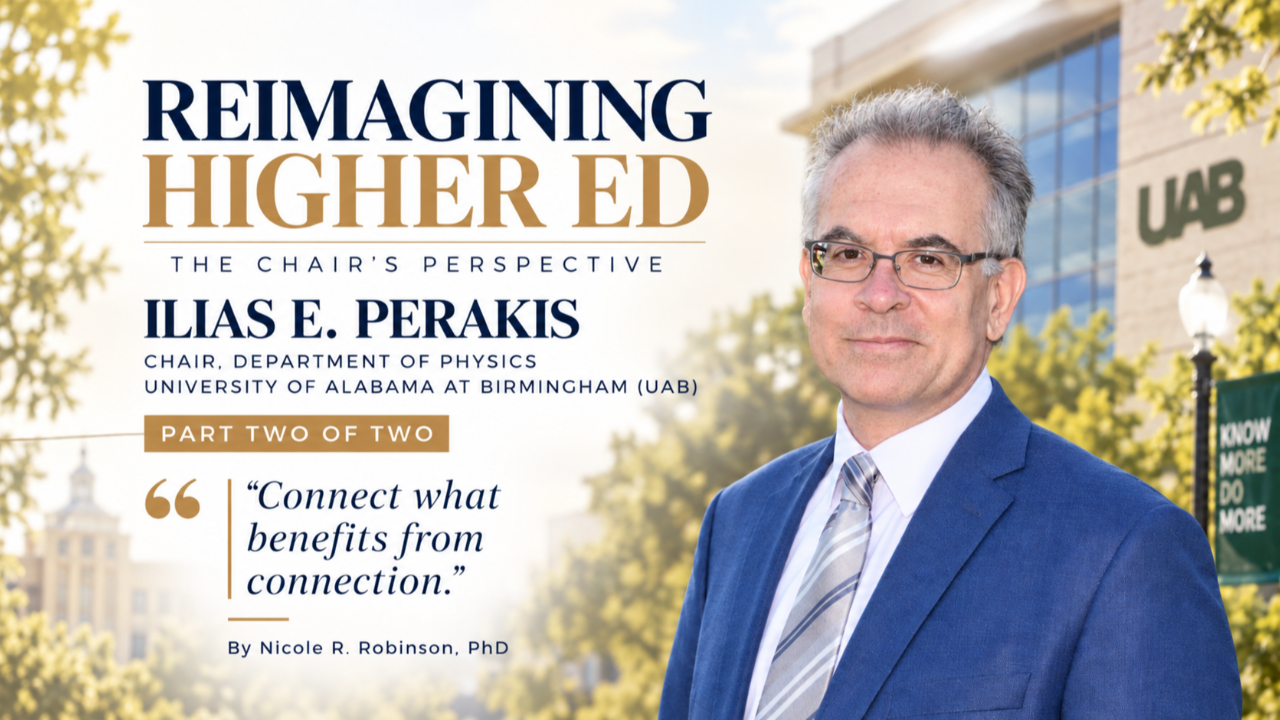
Ilias E. Perakis has spent more than three decades in research universities across the United States and Europe, working at the intersections of scientific research, faculty life, interdisciplinary collaboration, and academic leadership. Since 2015, he has served as Professor and Chair of the Department of Physics at the University of Alabama at Birmingham.
That breadth of experience initially drew me to his perspective. But as I read his responses, what interested me most was the vantage point from which he chose to examine the university: the department. Positioned between institutional priorities and the daily realities of faculty and students, the department is where decisions about strategy, resources, curricula, research, and academic opportunity become tangible. As Perakis puts it, this is where “strategy stops being language and becomes work.”
His perspective raises a question that higher education does not always ask when evaluating institutional change: What does strategy look like from the place where people must actually carry it out? Institutions typically examine change from the level where priorities are established and plans are approved. The department reveals something different: how those ambitions encounter disciplinary commitments, competing expectations, finite resources, and the people responsible for making them real.
From that vantage point, Perakis introduces a distinction that became central to our conversation: the difference between institutional complexity and fragmentation. For Perakis, complexity is not something universities should necessarily seek to eliminate. It is inherent to their purpose and, in many respects, one of their greatest strengths. The more consequential problem is fragmentation, the disconnection among disciplines, departments, people, and institutional priorities that prevents those different capabilities from contributing to something larger.
What I find particularly compelling about Perakis’s argument is how it changes the diagnosis of institutional dysfunction. If complexity is mistaken for the problem, the institutional response may be to simplify. But if fragmentation is the deeper condition, simplification may leave the actual problem untouched. The question becomes not how to make the university less complex, but how to strengthen the relationships through which its complexity becomes productive.
The View from the Middle
Perakis describes the department as a “translation layer of the university,” where disciplinary identity meets institutional purpose and broader ambitions encounter the realities of faculty work and student experience.
I find that description particularly revealing because translation is not simply implementation. It requires interpreting what an institutional priority means within a particular academic environment, recognizing what that environment can sustain, and sometimes reframing the question embedded in the original request itself.
One example from Perakis's leadership at the University of Alabama at Birmingham illustrates this distinction. When the institution sought to expand online education, the Department of Physics faced a question that could not be answered simply by moving courses into a digital format. Physics education depends on problem-solving, interaction, laboratories, feedback, and students learning to work through intellectual difficulty. Expanding access online without preserving those experiences could have increased enrollment while diminishing the quality of education.
Rather than treating the challenge primarily as a delivery-format problem, Perakis worked with faculty and college leadership to reconsider the design of the educational experience itself. The question became how distance-accessible Physics could serve UAB's health-focused mission while maintaining academic rigor and supporting student success. That required attention to pedagogy, laboratories, academic support, staffing, course quality, and a resource model capable of sustaining the program.
The results were substantial. Annual enrollments grew from approximately 100 to more than 2,500, while D/F/withdrawal rates declined from more than 25 percent to below 10 percent. The program expanded access for students across Health Professions, Nursing, Public Health, Arts & Sciences, and other areas of the university. Its courses subsequently earned Quality Matters certification and recognition through UAB's Provost's Transformative Online Course Award.
What interests me most about this example is not simply the scale of the growth. It is the institutional assumption that had to be reconsidered before that growth became possible. The original question concerned how to expand online delivery. The more consequential question concerned what kind of educational experience would advance the institution’s purpose and what conditions would it sustainable. One begins with a delivery mechanism. The other begins with institutional purpose and works toward the structures, resources, and practices required to realize it.
This distinction matters well beyond Physics. Universities routinely establish priorities around student success, interdisciplinary research, artificial intelligence, workforce preparation, and community engagement. Yet those priorities eventually reach departments already managing competing demands on faculty time, resources, and attention. A strategic commitment becomes a course someone must redesign, a partnership someone must maintain, a position someone must fund, or a student whose educational experience must change.
Perakis's perspective brings the practical questions into focus. Who will carry the work? What existing responsibilities must change? Do faculty understand the purpose? Are the necessary resources and authority available? What happens when the first approach fails?
These questions are sometimes treated as operational details to be resolved after a strategy has been established. But they may reveal whether the strategy was adequately designed in the first place.
That is what makes the department such a consequential vantage point for understanding institutional change. It reveals the distance between announcing an ambition and creating the conditions through which people can realize it. An institution may believe it has completed the strategic work when a priority has been approved. From the department, however, the most consequential work may only be beginning.
When Good Ideas Are Not Enough
Earlier in his career, Perakis placed more faith than he does today in the ability of a compelling idea, sound reasoning, and a well-developed strategy to produce progress. Experience challenged that assumption. He came to understand that even the strongest ideas depend upon people who trust the process, understand the purpose, and have the authority and capacity to carry the work forward.
He captures that evolution in a statement I find particularly revealing:
“When I care most, I listen longer and control less.”
That philosophy was tested when Perakis was brought in from outside to lead Materials Science and Engineering at the University of Crete. The department was deeply divided. Faculty disputes had reached the courts, junior faculty felt pressure to align with competing factions, hiring had stalled, and meetings could consume an entire day without producing decisions. The university was questioning the department's viability.
Perakis initially understood the challenge as organizational paralysis. The department needed to make decisions again. But what he discovered through his conversations with faculty changed his understanding of the problem.
“But I listened first. I met individually with faculty, spent time in their laboratories, and talked with people across the different groups, particularly junior faculty caught between the competing factions. What I heard changed my diagnosis. The problem was not simply that people disagreed or could not make decisions. They no longer trusted the process by which decisions were made.”
That discovery changed his approach. Before faculty meetings, Perakis began circulating the issues requiring decisions and inviting written arguments. He also shared his own recommendations and the evidence supporting them. Some colleagues considered that transparency risky given the department's history of legal disputes, but Perakis believed the greater risk was continuing to make decisions through processes people could neither understand nor trust.
For Perakis, consensus was never the objective. What mattered was that faculty understood the reasoning behind decisions, believed they had been heard, and trusted that the same standards applied to everyone. His approach began restoring confidence in the decision-making process, even when disagreements remained. Gradually, the department began moving again. Hiring resumed, longstanding infrastructure problems were addressed, and the university approved building space the department had unsuccessfully sought for years.
Years later, at the University of Alabama at Birmingham, Perakis encountered a different challenge that called upon the same leadership philosophy. At Crete, the department had been paralyzed by internal conflict and distrust. At UAB, the challenge concerned declining degree production, program viability, and questions about the future direction of Physics. Faculty were not necessarily opposed to change. They wanted to ensure that change strengthened rather than eroded the research identity and intellectual depth of their discipline.
Once again, Perakis began by listening rather than prescribing. What initially appeared to be an enrollment problem became a more fundamental question: “What should a strong Physics department at an urban, health-focused R1 university become for the twenty-first century?” Rather than determine that future independently, he engaged faculty in a planning process that allowed them to examine how the department's existing strengths could become the foundation for what came next.
What strikes me about these two experiences is not simply that Perakis listened. It is what listening allowed him to discover. At Crete, the obstacle was not disagreement itself, but a loss of confidence in how decisions were made. At UAB, what might have been interpreted as resistance reflected faculty concerns about protecting the intellectual identity of their discipline. In both instances, his approach revealed something the initial diagnosis had missed. In both cases, the institution’s capacity to move depended on repairing a different kind of disconnection: between faculty and the legitimacy of decisions at Crete, and between proposed change and disciplinary identity at UAB.
That distinction has important implications for how we think about reimagining higher education. We often begin with what needs to change: organizational structures, academic programs, institutional priorities, or ways of working. But Perakis's experiences push me to consider whether we sometimes begin too far downstream. Before institutions can determine what they should become, they may need to understand the conditions shaping how people experience the institution as it currently exists. What do people trust? What are they protecting? Which processes have lost legitimacy? What institutional strengths might be unintentionally diminished by the very changes intended to move the institution forward?
Perhaps reimagining higher education does not begin with a new vision. Perhaps it begins with a more accurate understanding of the institution we are asking to change.
That does not diminish the importance of vision. It suggests that the capacity to realize a vision depends upon whether leaders have correctly understood the institutional conditions through which it must move.
When Strategy Becomes Capacity
Perakis’s reflections lead to a question that I believe deserves greater attention in higher education: How should we measure the enduring contribution of institutional leadership? We often recognize leaders for what they accomplish during their tenure, the programs they establish, the partnerships they develop, the resources they secure, and the initiatives they move forward. But Perakis offers another measure. Did faculty gain the confidence and opportunity to lead something they could not have led before? Did students leave with greater capability? Did the department become less dependent on the person occupying the chair?
His approach to faculty mentoring at UAB Physics offers a practical example. Having recruited a substantial proportion of the department’s current faculty, Perakis could have positioned himself at the center of their professional development. Instead, he established a facilitated peer-mentoring structure through which early-career faculty could exchange ideas, offer candid feedback, develop collaborations, and build relationships independent of the chair. Over time, those relationships became part of the department’s culture rather than an initiative requiring his continued direction.
What interests me about this example is the distinction between leadership that produces results and leadership that builds institutional capacity. An institution can accomplish extraordinary things under a particular leader while remaining dependent upon that person’s judgment, relationships, and authority. The organization may appear strong precisely because the leader is compensating for capacities the institution itself has not developed. The more consequential question is whether the institution becomes capable of sustaining and extending the work without that individual remaining at its center.
That distinction brings me back to the department as the place where strategy becomes work. Perakis’s experiences suggest that institutional strategy is not fully realized when a priority has been announced, a program redesigned, or a new direction approved. It becomes more durable when people understand its purpose, possess the authority and resources to act, and develop the relationships and judgment necessary to carry it forward. The measure of implementation, then, is not simply whether the institution accomplished what it intended, but whether it became more capable in the process.
Across these experiences, Perakis makes visible a sequence that institutional strategy often obscures. A priority must first be translated into the realities of academic work. Leaders must understand the conditions that shape whether people can participate in that work, including trust, identity, authority, and resources. Finally, the work must become something the institution can sustain beyond the individual who initiated it.
What I find most compelling about Perakis’s perspective is that he has pushed me to reconsider where the work of reimagining higher education actually begins. His experiences remind me that institutional transformation is not simply about developing a compelling vision or identifying what needs to change. It requires understanding the institution deeply enough to recognize what must be preserved, what conditions must be reconsidered, and how to build the capacity for people to carry something new forward. His thinking has challenged me to look beyond what institutions might become and ask whether we are building the institutional capacity necessary to make that future possible.
And perhaps that is what I value most about this conversation. Perakis has given me new questions to carry into my own work, questions I might not have asked in quite the same way without the benefit of his experience and perspective. His distinction between complexity and fragmentation, and his understanding of the department as the place where institutional ambition becomes work, have expanded my thinking about what it means to reimagine higher education. They also lead us toward the next question: How do we strengthen the connections among the university’s distinct parts without diminishing the intellectual differences that make those parts valuable?
That is the question we will explore in Part II.
About Ilias E. Perakis
Ilias E. Perakis, PhD, is Professor and Chair of the Department of Physics at the University of Alabama at Birmingham. He joined UAB in 2015 and is a Fellow of the Optical Society of America, now OPTICA, recognized for contributions to the many-body theory of the coherent optical properties of semiconductors and metals. His academic career has included faculty and leadership roles at Vanderbilt University and the University of Crete, as well as visiting appointments and research collaborations in the United States and Europe. His research has been supported by the National Science Foundation, the U.S. Department of Energy Basic Energy Sciences, and the European Union.
About The Chair’s Perspective
The Chair's Perspective is a Reimagine Higher Ed editorial series examining what higher education must understand, preserve, reconsider, and build for what comes next. Each editorial begins with the experiences and reflections of a department, then examines the larger institutional questions their perspective brings into view.