Don’t Just Read the Questions. Read What They’re Doing.
I have read Secretary Linda McMahon’s A National Call to Action to University Presidents and Governing Boards (August 3, 2026) several times.
The Department of Education asks colleges and universities to answer seven questions addressing admissions, free speech, intellectual pluralism, affordability, artificial intelligence, research integrity, and national priorities.
But the more I read, I kept returning to one sentence:
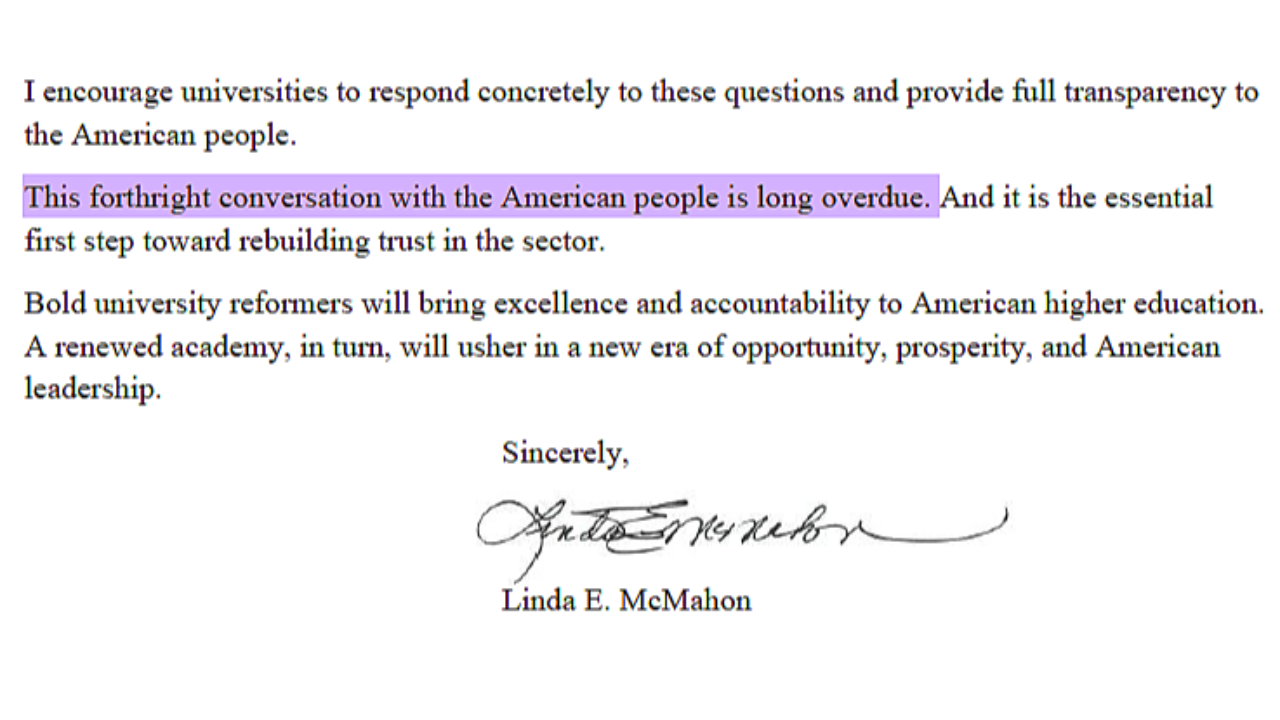
“This forthright conversation with the American people is long overdue.”
That sentence gave me pause.
Rhetorically, the letter creates the impression that universities have not been talking to the American public.
Yet universities already publish admissions standards, tuition and fees, accreditation reports, audited financial statements, strategic plans, graduation rates, research, faculty scholarship, governance records, and public accountability reports. Public universities also operate under open records laws.
So if higher education already engages in public accountability, what exactly is this new form of “accountability” about?
I pulled the document apart using my 4P Framework™: People, Place, Process, and Power.
People? The federal government, universities, governing boards, faculty, students, and the American public.
Place? Higher education and its relationship to society.
Process? The seven questions.
Then I reached Power.
That is when the document looked completely different.
The seven questions are not the story.
They are the process.
And process is often the mechanism through which institutional power operates.
In this case, the institution exercising that power is the federal government, through the Department of Education, over colleges and universities across the United States.
At first glance, the letter appears to be about accountability.
It isn’t.
At least, not primarily.
This is about power.
It is about the federal government’s effort to shape the future direction of American higher education.
The mechanism is remarkably simple: seven questions.
Through those seven questions, institutions are expected to engage in what the Department calls “this forthright conversation with the American people.”
But will this be a conversation?
A conversation is reciprocal. It creates space for inquiry, clarification, disagreement, and listening on all sides.
In this case, the conversation becomes the mechanism of power because universities are expected to participate in it without actual dialogue or space to explain institutional complexity, discuss necessary trade-offs, correct misunderstandings, or ask questions in return.
Should there be a national conversation about higher education?
Absolutely.
Should universities answer difficult questions?
Without question.
Should the American public expect accountability from its colleges and universities?
Absolutely.
But presenting universities with seven predetermined questions and calling their responses a conversation does not make it one.
Participation in this conversation could shift authority over how colleges and universities define their missions, priorities, and academic purposes.
Power is often a covert player.
The most consequential exercise of power is not always forcing an institution to change.
It is establishing the framework that leads institutions to change themselves.
Universities should consider not only what these questions ask, but what answering them may require them to become.