Connect What Benefits From Connection | Ilias E. Perakis, University of Alabama at Birmingham | Pt 2
What Ilias E. Perakis’s perspective reveals about preserving disciplinary depth while building a more connected university.
By Nicole R. Robinson, PhD
A Reimagining Higher Ed editorial informed by Ilias E. Perakis’s written responses to Nicole R. Robinson.
In Part One of this Chair’s Perspective, Ilias E. Perakis’s view from the department led us to consider what happens when institutional strategy reaches the people expected to make it real. From that vantage point, strategy becomes capacity, workload, authority, resources, trust, and human judgment.
But his perspective raises another question.
If fragmentation is the problem, what exactly should higher education reconnect?
The answer is not everything.
Connection Without Sameness
Higher education increasingly speaks about interdisciplinarity as an institutional good, and for good reason. Perakis points out that many of the problems universities are being asked to help address do not arrive organized according to departmental boundaries. Artificial intelligence, healthcare, quantum technologies, sustainability, energy, economic mobility, data, and community well-being require different forms of knowledge to interact.
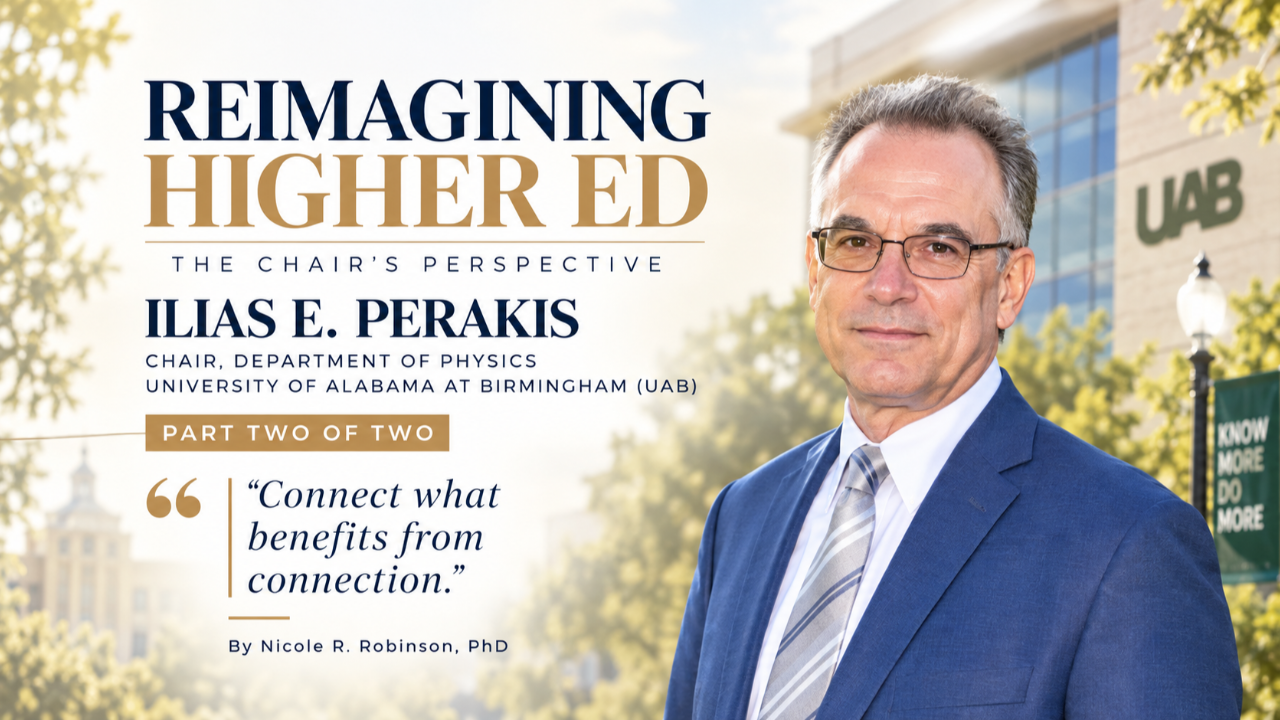
But Perakis does not conclude from this that disciplinary boundaries themselves are the problem. In his experience, the strongest collaborations begin with people who know something deeply and then discover a compelling reason to work across a boundary. The goal, as he puts it, should not be to make every academic unit look alike. It should be to “connect what benefits from connection.”
That formulation sharpened the distinction for me because it requires the institution to distinguish between difference and isolation. A department can be distinct without being disconnected. A discipline can protect the intellectual traditions that give it strength without becoming closed to what another discipline might contribute. An institution can contain strong academic units without requiring those units to operate as separate systems.
Perakis has encountered that tension repeatedly throughout his career. At the University of Crete, his work included an initiative that connected scientific education with ethics, civic responsibility, and public dialogue. His leadership in Materials Science required collaboration across physics, chemistry, engineering, computation, lasers, and biological applications. At UAB, he describes strengthening the disciplinary foundations of Physics while connecting them more intentionally to computation, data, materials, quantum, photonics, health-related applications, experiential learning, workforce development, and community engagement.
What matters in those examples is not simply that collaboration occurred. Perakis is explicit that the objective was not to make Physics less rigorous in order to make it more relevant. It was to make disciplinary strength the foundation for broader contribution.
That distinction raises a question I think higher education will have to confront as demands for interdisciplinarity continue to grow: Have we sometimes confused collaboration with sameness?
Perakis’s answer is that the alternative to silos is not sameness. Some boundaries protect intellectual depth; others simply make connection harder. Physics, for example, has developed a distinctive way of thinking through mathematical reasoning, modeling, experimentation, and the continual testing of theory against evidence. That depth would lose value if it were diluted simply to make a program appear interdisciplinary. What he would make more permeable is the organizational boundary that prevents disciplinary depth from interacting with other forms of knowledge.
As AI-related programs proliferate, Perakis says that he has resisted the assumption that every new intersection requires a new interdisciplinary degree. In his view, interdisciplinarity does not mean creating broad programs whose intellectual center becomes unclear. At UAB, Physics retained a rigorous disciplinary core while becoming very connected to AI, advanced computation, data science, materials and quantum science, health applications, experiential learning, and community-engaged education.
The aim is not to weaken disciplinary boundaries. It is to distinguish the boundaries that protect intellectual depth from those that merely prevent useful connection.
Reimagining the university may not require eliminating boundaries. Perakis’s perspective instead invites a more discerning examination of what those boundaries are doing. Some boundaries protect intellectual depth. Some create meaningful differentiation. Others may have hardened into walls that prevent knowledge, people, and opportunity from reaching one another.
The work is not to remove every boundary. It is to understand which boundaries continue to serve an intellectual purpose and which now function primarily as barriers to connection.
Where Fragmentation Becomes Visible
The department also gives Perakis a particular view of strategy. He observes that it is relatively easy to write an aspiration and considerably harder to create the conditions that make that aspiration possible. Eventually, every institutional priority arrives somewhere as a practical question about workload, resources, authority, faculty understanding, curriculum, hiring, or implementation.
I think this is one of the most consequential ideas in his responses because it made me think about where fragmentation actually becomes visible. It is not always apparent in the strategic plan. Sometimes it becomes visible only when the plan reaches the people responsible for carrying it.
An institution may identify several priorities, each of them legitimate and strategically important. One asks for new programming. Another requires increased faculty participation. Another introduces new assessment expectations. Another expands student engagement. Another calls for interdisciplinary collaboration. At the institutional level, these may appear as separate initiatives. At the department level, they may all arrive at the same door, carried by the same people, competing for the same calendar, budget, attention, and finite organizational capacity.
This is where Perakis’s scientific background adds another useful dimension to his leadership perspective. His operating principle is straightforward: “diagnose before prescribing.” The visible symptom, he argues, is not necessarily the underlying problem. A struggling program may not simply have a marketing problem. Faculty hesitation may not simply represent resistance to change. An institution may contain talented people and promising initiatives and still make limited progress because the connections among those people, initiatives, structures, and resources remain weak.
That framing pushed me to think differently about the speed with which institutions often diagnose what they see. Enrollment falls, and the response is marketing. Faculty hesitate, and the response is communication. Engagement declines, and the response is programming. Workforce concerns increase, and the response is credentials. Artificial intelligence emerges, and the response is policy.
Sometimes those interventions may be exactly right, but Perakis’s perspective invites a prior question: what if the visible problem is occurring in one part of the institution while its cause lives somewhere else? Are we treating a symptom before the underlying problem has been understood?
A student success problem may also be a curriculum problem. A curriculum problem may also be a workload problem. A collaboration problem may be an incentive problem. A faculty engagement problem may be a trust problem. An implementation problem may be an authority problem. A strategy problem may actually be a capacity problem.
Fragmentation makes those relationships harder to see because each part of the institution encounters only one portion of what is happening.
When Perakis arrived at UAB, the most visible concerns were degree and credit-hour production. It would have been easy to define the problem primarily as enrollment or marketing.
But looking across enrollment, degree-production, course-demand, and student-success data, and listening to faculty about the department’s strengths and concerns, led him to a broader diagnosis. The issue was not simply how to attract more students. The student experience itself was fragmented. Research, mentoring, curriculum, emerging fields such as computation and data, career preparation, and external opportunities existed, but they were not yet connected into a coherent pathway.
So the department redesigned the system.
Over time, what emerged was less a collection of separate initiatives than a reinforcing cycle. Strategic faculty recruitment and mentoring strengthened research and funding capacity. Stronger research created more opportunities for undergraduates. Those experiences enriched curriculum, mentoring, and student capability. Internships, experiential learning, and community partnerships connected that education to careers and public problems. Stronger student outcomes, enrollment, research performance, partnerships, and revenues then created additional capacity to invest back into faculty, research, and students.
The important point was not simply that each part grew. It was that the parts began strengthening one another. Majors and credit-hour production increased by roughly 40 percent, the five-year average of B.S. degree production rose by more than 60 percent, undergraduate research participation increased approximately fourfold, and research expenditures also grew substantially.
The chair’s vantage point can expose more of those connections because the department sits close to both the institutional expectation and the people experiencing what that expectation requires. Perakis captures the balance in another leadership principle: “Be demanding about the mission and respectful toward the people.”
I hear two responsibilities inside that statement. Leaders should not reduce the aspiration simply because implementation is difficult. But neither should they assume that difficulty implementing the aspiration means the people are the problem.
What Became Possible?
One of the places where Perakis says his thinking has shifted most significantly is in the relationship between academic education and the world students enter after graduation. He once thought of career preparation as something that followed education. He increasingly understands it as part of education.
That distinction matters because higher education often frames this conversation as a choice between competing purposes. Education or employment. Intellectual development or workforce preparation. Learning for its own sake or preparation for what comes next.
Perakis’s responses pushed me toward a more integrated question: what if helping students understand how their learning becomes capability is itself part of the educational responsibility?
At UAB Physics, he describes thinking about the student experience as a pathway extending from enrollment toward employment or advanced study. Research, internships, computational and data skills, mentoring, community-based learning, and career exploration become parts of that pathway rather than disconnected opportunities students may or may not happen to discover.
From that framing comes a question I find particularly consequential: “What became possible for our students because of the education we provided?”
That question pushed my thinking beyond completion as a sufficient measure of educational value. Courses matter. Degrees matter. Credentials matter. But they primarily describe what the student moved through.
Perakis’s question asks what the education enabled. What can the student now understand, do, imagine, and enter because of what the institution made possible?
And here again, his emphasis on fragmentation opened another line of inquiry for me. A student may belong to one university while experiencing multiple institutions within it. Courses exist in one place. Advising somewhere else. Career preparation in another office. Research opportunities may depend upon discovering the right faculty member. Internships may be housed somewhere else again. Community engagement may operate through another structure entirely.
The university may understand all of those experiences as components of one education, while the student experiences them as a collection of opportunities requiring the student to make the connections alone.
That raises another reimagining question. If we believe education is larger than the accumulation of courses, how intentional are we about helping the different parts of the student experience become coherent?
Integration, in that sense, is not only an organizational challenge. It is an educational one.
Perakis argues that students are too often asked to reverse-engineer the university for themselves. Research may be valuable, but students are left to find the right faculty member. Internships may matter, but students often have to discover those opportunities on their own. Advising, career services, mentoring, coursework, research, and community engagement may each be strong individually, yet the student is still expected to assemble them into a coherent educational experience.
In his view, institutions should design more of that coherence rather than depend on student serendipity.
For Perakis, connecting knowledge also raises a larger question: connected for what?
His answer is public value.
He does not see community engagement as something universities add after teaching and research are complete. At its best, he argues, engagement becomes part of how students learn, how knowledge is created, and how a public research university contributes to the place it serves.
That idea has followed him across institutions. At the University of Crete, the Scientist–Citizen initiative connected science with ethics, civic responsibility, and public dialogue in the city, while internship programs brought students into schools, public organizations, and companies.
At UAB, the Magic City Data Collective public-private partnership has connected students with Birmingham nonprofits and community organizations through paid, mentored projects in which students use data to address real problems. Building Futures extends that idea earlier in the educational pipeline by connecting Birmingham-area students with mentoring, STEM opportunity, research, scholarships, and work-based learning.
The common principle is that the community should not merely be the audience for what a university knows. It can become part of the learning and knowledge-creation ecosystem itself.
A university should not only educate students and hope that regional value follows. It can deliberately connect education, talent, employers, civic organizations, and knowledge so that the region becomes more capable.
For Perakis, that is what “Create Public Value” means: connecting disciplinary expertise and student development with problems that matter beyond the campus, in ways that strengthen both the community and the university.
The Next Challenge Is Integration
Artificial intelligence makes that question more urgent.
Perakis does not frame the central AI question as whether universities should simply permit or prohibit particular uses of the technology. He asks what students will need as information and routine analytical capabilities become increasingly abundant because of AI.
His answer is deeper disciplinary knowledge accompanied by judgment, adaptability, quantitative and data fluency, communication, ethical reasoning, curiosity, and the ability to work across boundaries institutions have often treated as fixed.
Perakis sees a fundamental shift in what Physics education should value as AI becomes more capable. The educational premium is moving from producing an answer toward exercising judgment about the problem itself: how to frame it, which model to use, what assumptions are being made, how to test the result, whether the output makes physical sense, and what it ultimately means.
That emphasis predates generative AI in his own teaching. Years ago, he developed a freshman active-learning course, Physics through Concept Grinders, designed to make students wrestle with conceptual problems, explain their reasoning, and learn without simply being handed the correct answer. For Perakis, AI makes that kind of “social learning” more important, not less.
The same principle applies in research. In condensed-matter physics, AI can help screen large spaces of possible materials, accelerate computation, and generate or modify code. But deciding which question is worth asking, which physical model is appropriate, what approximations are defensible, how a calculation should be validated, and whether an apparently successful result is scientifically meaningful still requires human judgment.
That is why Perakis distinguishes data fluency from digital literacy. Students should not merely know how to operate computational or AI tools. They should know how to reason with data, construct and test models, recognize uncertainty, challenge assumptions, and know when an answer should not be trusted.
During his chairship, UAB Physics has increasingly built those capabilities through computational modeling, project-based learning, collaborative discussion, undergraduate research, and work on real-world problems. Perakis also sees the role of graduate teaching assistants changing. As routine assistance becomes easier to automate, their human contribution becomes more valuable: questioning students, challenging their reasoning, tutoring through difficulty, providing feedback, and helping students learn how to think rather than simply obtain an answer.
What interests me here is that his argument about fragmentation begins to extend beyond organizational design. The question is no longer simply whether departments are connected to one another. It becomes whether the different purposes of the university are connected: research and education, disciplinary knowledge and real problems, technological capability and human judgment, universities and the communities they serve.
Perakis sees departments as useful places to begin because they operate at an interesting scale. They are close enough to disciplines to protect intellectual depth and close enough to faculty, students, and staff to experiment practically.
Consequential change can begin with something relatively small: a research experience, a new course, a mentoring structure, an employer partnership, or a community project. If something works, leadership can then connect it to other efforts, resource it, learn from it, and gradually build greater institutional capacity.
He captures that process in a sentence that I think deserves attention: “Change rarely happens by memo. It happens when people can see that something works.”
That observation pushed me to think about higher education’s tendency to begin change conversations with scale. We often ask how to implement something institution-wide, how to standardize it, or how to make everyone participate.
Perakis’s response suggests that some institutional change may need to begin with a different question: where can we allow an idea to become real enough that people can see what becomes possible?
An institution does not always need a university-wide answer first. Sometimes it needs a place where the possibility becomes visible, where people can test it, learn from it, improve it, and develop enough confidence in what they are seeing to decide whether it deserves broader investment.
What Reimagining Must Preserve
For all of his emphasis on connection, experimentation, and change, Perakis is equally clear that reimagining should not become an excuse for abandoning what universities uniquely provide.
He identifies rigorous inquiry, academic freedom, disciplinary depth, the intellectual relationship between faculty and students, and the ability to pursue questions whose value may not be immediately measurable as things worth protecting. He also points toward the university’s unusual capacity to think beyond the next quarter, election, funding cycle, technological fashion, or immediate pressure.
His response complicates the fragmentation argument in an important way.
Not everything separated should be combined. Not everything old should be replaced. Not every boundary is a barrier, and not every tradition is evidence that an institution has failed to evolve.
Perakis frames the challenge this way: “The challenge is not to choose between preservation and change. It is to know what deserves to be preserved and what has merely become familiar.”
I think that distinction sits near the center of any serious attempt to reimagine higher education. A familiar structure is not necessarily obsolete because it is old. A new structure is not necessarily better because it is new. A disciplinary boundary may protect intellectual depth, while another may simply make meaningful collaboration harder. An institutional process may preserve something important, while another may continue because no one has stopped long enough to ask what purpose it still serves.
What Perakis adds to that larger question is the issue of connection. The work is not simply determining what deserves to remain. It is also asking whether the things we preserve are connected well enough to accomplish the purposes for which we are preserving them.
A university may preserve disciplinary rigor and still leave disciplines isolated. It may preserve research and teaching as central missions while allowing the relationship between them to weaken. It may preserve a rich array of opportunities for students without ensuring those opportunities ever become a coherent educational experience.
Reimagining, then, requires more than discernment about what stays and what changes.
Perakis’s perspective suggests that we must also ask what needs to be reconnected.
What Would We Build Again?
After more than thirty years in higher education, Perakis describes his work in three phrases: “Build People. Connect Knowledge. Create Public Value.” What strikes me is that each of those aspirations depends upon relationship. Building people requires connection among expectation, authority, opportunity, support, accountability, and trust. Connecting knowledge requires disciplinary depth strong enough to be able to contribute something meaningful, together with institutional pathways that allow that knowledge to encounter something beyond itself. Creating public value requires a relationship between what universities know, what they teach, what they discover, and the people and communities whose lives that knowledge might affect.
None of those things happens through declaration alone, and perhaps that is what Perakis’s view from the department allows us to see particularly clearly. A university can appear integrated from the top while feeling fragmented from the middle. A strategy can read coherently in a planning document while reaching departments as a series of separate demands competing for the same people and resources. A student can belong to one institution while experiencing a collection of courses, offices, opportunities, and expectations that never quite become a whole. A university can contain extraordinary expertise while creating too few pathways for that expertise to encounter itself.
None of those conditions requires the university to become less complex. They require it to become more connected.
That brings me back to the distinction that first caught my attention in Perakis’s responses. If institutions mistake fragmentation for complexity, they may spend enormous energy simplifying structures when the deeper need is to strengthen the relationships among them. They may centralize when they should connect, standardize when they should translate, add another initiative when they should understand why the existing pieces are not working together, or ask individuals to collaborate more without examining whether the institution has created the conditions through which meaningful collaboration becomes possible. While centralization, standardization, or a new initiative can each be the right answer, the point is that diagnosis should precede the remedy.
Perakis ends his reflections with a question: “If we were designing a university today around the people we serve, the knowledge we seek to create, and the public value we hope to produce, which parts of the institution we inherited would we deliberately build again, and which would we build differently?”
His question takes us directly into the work of reimagining higher education, but his earlier reflections lead me to add another: Among the parts we would build again, how differently might we connect them?
Perakis would build strong academic departments again. Disciplines remain one of the most effective ways universities create intellectual depth, scholarly community, mentorship, identity, and a home for developing expertise. He would not abandon that structure simply because many of today’s most consequential problems are interdisciplinary.
What he would reimagine is how the college connects those departments. As he puts it, strong departments create depth; a strong college creates the connections that allow that depth to become something larger.
Those connections, however, need to be designed rather than left to chance. Many colleges are still organized primarily to administer disciplines vertically, while emerging challenges, from AI and health to sustainability, data, and workforce transformation, increasingly require disciplines to work horizontally as well.
Perakis therefore sees the college less as a collection of units reporting upward and more as a team of teams: strong departments with meaningful autonomy and accountability, connected by shared purpose, trusted relationships, transparent information, and opportunities to build together. In that model, the dean’s role is not to centralize the expertise that lives in departments, but to create the conditions that allow that expertise to find one another, align around consequential problems, and act collectively when connection creates value.
If he could reconnect one part of the university first, Perakis would begin by linking undergraduate education more intentionally with research and real-world learning.
Students should encounter knowledge not only as something already discovered and presented to them, but as something they can participate in creating and applying. Research and real-world learning develop judgment, resilience, curiosity, collaboration, and the ability to work on questions for which the answer is not already known, capabilities that become more important as AI makes information and routine analytical work increasingly abundant.
At UAB Physics, initiatives such as Building Futures in Birmingham and the Magic City Data Collective extend that principle beyond a single course or department by connecting mentoring, research, community problems, experiential learning, city as a classroom, and opportunity rather than leaving students to assemble those experiences on their own.
The larger goal is not to erase the university’s parts, but to make those parts capable of doing more together.
Perhaps the university of the future does not require fewer disciplines, fewer ideas, fewer ambitions, or fewer differences. Perhaps it requires an institution more capable of allowing those differences to become something together without erasing what makes them valuable in the first place.
That is a very different project from simplifying higher education. It is the harder work of building coherence without demanding sameness, preserving depth without accepting isolation, and ensuring that institutional ambition remains connected to the people who eventually have to make it real.
Complexity may be inherent to higher education. Fragmentation does not have to be.
About Ilias E. Perakis
Ilias E. Perakis, PhD, is Professor and Chair of the Department of Physics at the University of Alabama at Birmingham. He joined UAB in 2015 and is a Fellow of the Optical Society of America, now OPTICA, recognized for contributions to the many-body theory of the coherent optical properties of semiconductors and metals. His academic career has included faculty and leadership roles at Vanderbilt University and the University of Crete, as well as visiting appointments and research collaborations in the United States and Europe. His research has been supported by the National Science Foundation, the U.S. Department of Energy Basic Energy Sciences, and the European Union.
About Reimagining Higher Ed: The Chair’s Perspective
The Chair’s Perspective is part of Reimagine Higher Ed’s ongoing inquiry into what higher education must understand, preserve, reconsider, and build for what comes next. Each editorial begins with the experiences and reflections of a department chair, then examines the larger institutional questions their perspective brings into view.